

What is the EU VAT reverse charge mechanism?
In a standard VAT transaction, the supplier charges VAT, collects it from the customer, and remits it to the tax authority. The EU reverse charge mechanism inverts that responsibility. For qualifying cross-border B2B transactions within the EU, the buyer accounts for the VAT directly, and the supplier issues an invoice without it.
The reverse charge mechanism is also referred to as the reverse charge procedure. Both terms describe the same process and are used interchangeably across EU member state guidance.
Understanding when the mechanism applies, and what it requires from both parties, is essential for any business operating across EU borders. Getting it wrong in either direction creates compliance exposure: charge VAT when you should not, and your customer faces an unnecessary cost. Fail to apply the reverse charge when you should, and you may face penalties from the tax authority.
This guide explains how the EU reverse charge mechanism works, who it applies to, and the most common compliance mistakes to avoid.
Note: the UK left the EU VAT system on 1 January 2021. If you are trading between the UK and EU, or need to understand how the reverse charge applies in the UK specifically, see our guide: How to apply the VAT reverse charge in the UK.
How does the EU VAT reverse charge mechanism work?
In a traditional VAT system, the general rule is that the supplier charges VAT on their supply of goods or services, collects tax from the customer, and remits it to the tax authorities.
However, under the reverse charge mechanism, the customer is responsible for paying VAT due on a transaction directly to the tax authorities. In this case, the supplier issues an invoice without VAT, and indicates a reference to the reverse charge mechanism on it. This reference is a mandatory invoicing element in the EU as per Section 226 of the EU VAT Directive. The buyer then calculates and pays any VAT due to the tax authorities and reports this as part of their VAT return.
Why was the EU reverse charge mechanism introduced?
This system was introduced to simplify the taxation of intra-community supply transactions, especially for EU businesses dealing with foreign business customers. In the absence of this mechanism, there were two practical issues:
- Increased compliance burden: businesses would need to register in every EU Member State to collect and remit taxes greatly increasing the compliance burden
- Increased VAT fraud risk: local tax authorities would have an increased risk of tax fraud as non-established (and therefore harder to chase and enforce rules against) taxpayers could disappear with the local VAT they have collected.
When does the reverse charge mechanism apply?
The reverse charge mechanism in the EU simplifies the VAT rules for businesses that operate across multiple EU member states and is designed specifically for cross-border sales in business-to-business (B2B) transactions.
Who can use the reverse charge mechanism?
It's important to note that the reverse charge mechanism does not apply to business-to-consumer (B2C) transactions; only transactions between “taxable persons” are subject to this mechanism in the EU. For the purposes of the reverse charge, a taxable person is typically, but not always, in possession of a valid VAT number that can be found via the EU VIES portal.
One of the main reasons why the VAT reverse charge mechanism is not applicable to B2C transactions is that customers who are non-taxable persons, such as individual consumers, do not have a VAT registration number and, consequently, cannot self-assess VAT under the reverse charge mechanism. Therefore, checking whether your business partner has a valid VAT number can be crucial when applying the reverse charge.
If you're a business owner operating within the EU and engaging in cross-border trade, it's important to be familiar with the EU's reverse charge mechanism and the related VAT reporting rules.
EU VAT reverse charge examples: How it works in practice
To better understand how the EU reverse charge mechanism works, let's take a look at a practical example.
Example 1: Standard domestic VAT transaction
Based on the general rules, the supplier includes VAT in their invoice for goods or services sold to a customer. For example, if a business supplies services for €100 in Germany, where the VAT rate is 19%, the supplier would charge the customer €119 (€100 + €19 VAT) and then remit the collected €19 VAT to the tax authorities - as according to the general rules, this is the supplier’s responsibility - by including it as payable VAT in its VAT return.
Example 2: EU cross-border reverse charge transaction
Now let's look at a cross-border EU supply of services transaction between two businesses to which the reverse charge mechanism applies. In the case of reverse charge, the responsibility of remitting the VAT amount to the tax authorities shifts from the supplier to the customer (the responsibility is “reversed”). Let’s assume that a VAT-registered business in Germany purchases services worth €100 from its business partner in Italy. As per the place of supply rules (“where to tax” rules), German VAT should apply to this transaction. In this case, the Italian business partner will issue an invoice without VAT but with a reference that the reverse charge mechanism applies. The gross amount will equal the net amount because VAT will not be applied to the invoice. When the German customer receives the reverse charge invoice, they will need to assess and remit the €19 German VAT in their German VAT return, as now the responsibility of remitting the VAT to the tax authorities is shifted - it is now sitting with the customer.
Common reverse charge VAT mistakes and compliance risks
There are a couple of common issues to look out for:
- Incorrectly coding reverse charge transactions: on some occasions, transactions subject to the reverse charge are incorrectly recorded as zero-rated domestic purchases instead of cross-border purchases subject to the VAT reverse charge. This is common in large companies with dedicated accounts payable teams. The miscoding can result in VAT return errors and additional questions from tax authorities.
- Using unnecessary legal references on invoices: many EU business invoices still opt to cite the full reference to the law containing the exemption for charging VAT (articles 44 and 196 of the EU VAT Directive). Many customers find this legalise language on invoices confusing and pompous. The EU now permits you to simply say “reverse charge” for cross-border transactions. See these helpful EU invoicing page for more information.
- Domestic reverse charge: There is also the domestic reverse charge which was introduced specifically to target instances of VAT fraud that we have not talked about in this blog post, but if you need more information, you can find it here.
What are the benefits of the EU VAT reverse charge mechanism?
The reverse charge is meant to reduce the administrative and compliance burden on foreign suppliers providing services in jurisdictions where they do not have a presence.
Benefits for suppliers
From the supplier’s perspective, without a reverse charge mechanism in place, they would typically be required to register in the customer’s country for VAT purposes, collect and remit local VAT, and also fulfil all relevant VAT obligations in these jurisdictions. This can be a time-consuming and burdensome process for foreign suppliers (think about lack of knowledge on local tax processes, language barriers, significant administrative costs, consultancy fees, etc.). By having the responsibility reversed, suppliers do not need to VAT register in the customer’s country.
Benefits for customers
Viewed from the customer’s angle, by accounting for the VAT on supplies received from foreign suppliers, customers can ensure that they are complying with the relevant tax laws and regulations in their own jurisdiction. Instead of the supplier charging and collecting VAT, the customer accounts for this VAT directly on their VAT return (this is called output VAT). As long as the purchase has a legitimate business purpose, the customer can normally deduct this VAT paid directly on the same VAT return (this is called input VAT). As a result, the numerical effect of the reverse charge mechanism on the customer's VAT liability is zero, as the VAT payable can normally be offset by the input VAT credit claimed on the same VAT return.
Benefits for tax authorities
From the standpoint of the tax authority, the reverse charge reduces the risk of non-payment of VAT by non-resident suppliers. Since the local tax authority already has personal jurisdiction over the customer, it is easier to ensure VAT payments and VAT compliance if these responsibilities fall to the customer.
The EU’s VAT reverse charge procedure is an essential tool for simplifying the taxation of cross-border transactions within the EU, especially in the context of B2B sales. It supports the EU's goal of taxing products and services in the Member States where they are consumed and helps reduce the administrative burden for businesses that operate across multiple Member States. It is important for businesses to understand when the reverse charge rules apply and to who it applies, as failure to comply with the VAT rules can result in significant penalties and fines.
Managing EU VAT reverse charge compliance at scale
The EU reverse charge mechanism simplifies cross-border VAT for businesses and tax authorities alike. Suppliers avoid registering in every member state where they have customers. Customers account for VAT directly, with a corresponding input VAT credit that typically leaves their liability unchanged. Tax authorities reduce their exposure to non-resident suppliers disappearing with collected VAT.
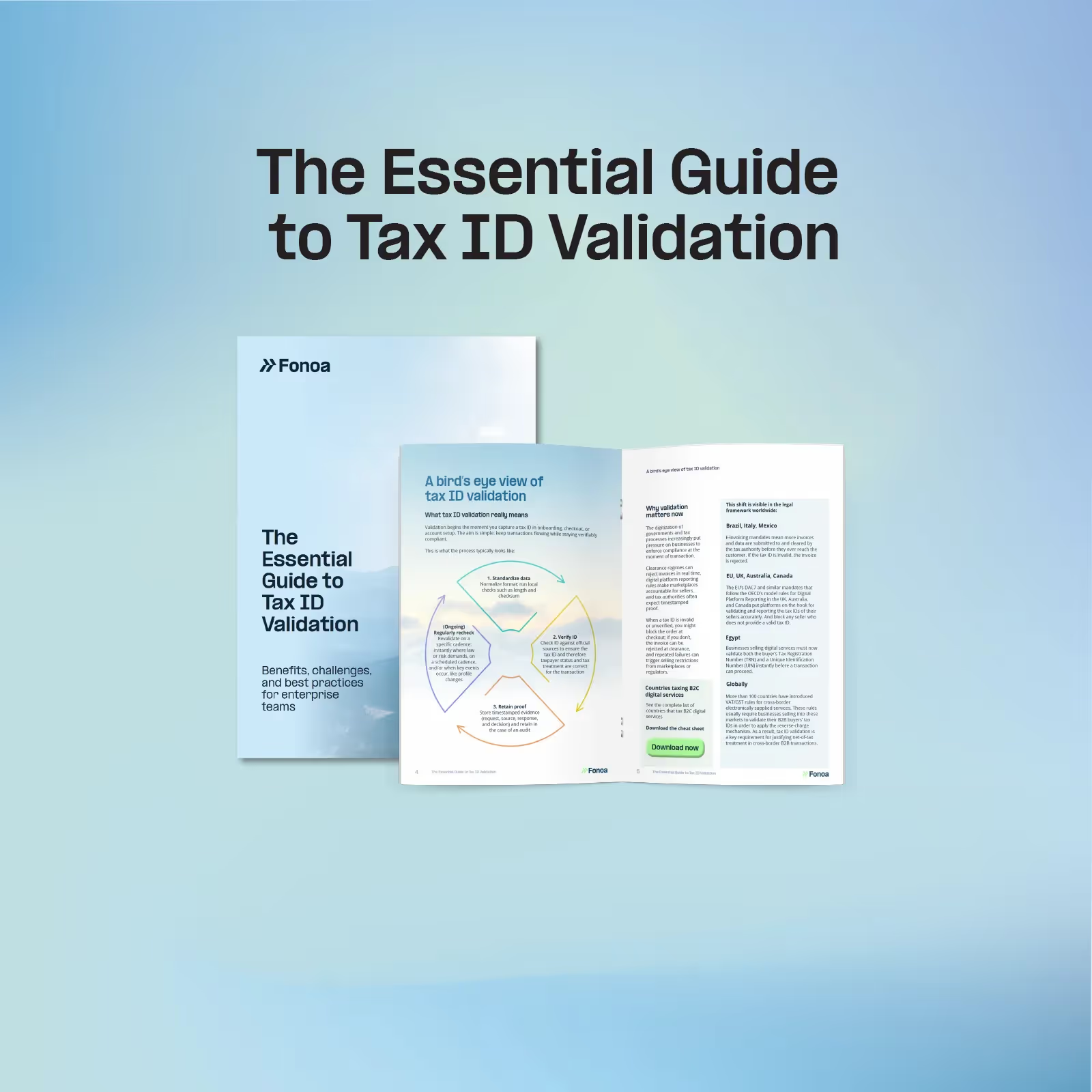
What the mechanism does not simplify is the validation work that sits underneath it. Applying the reverse charge correctly depends on confirming that your business partner holds a valid VAT number, which is what establishes them as a taxable person eligible for the treatment. If that validation is missing or invalid, the reverse charge may not apply, and the consequences fall on the supplier.
For businesses with high transaction volumes across multiple EU member states, managing that validation at scale is where complexity accumulates. Fonoa validates VAT numbers across 120+ countries, including direct verification through the EU VIES portal, and maintains a complete audit trail for every check. That record becomes your evidence in the event of a future audit challenge.
Get in touch to find out how Fonoa can support your indirect tax compliance across the EU and beyond.






.jpg)