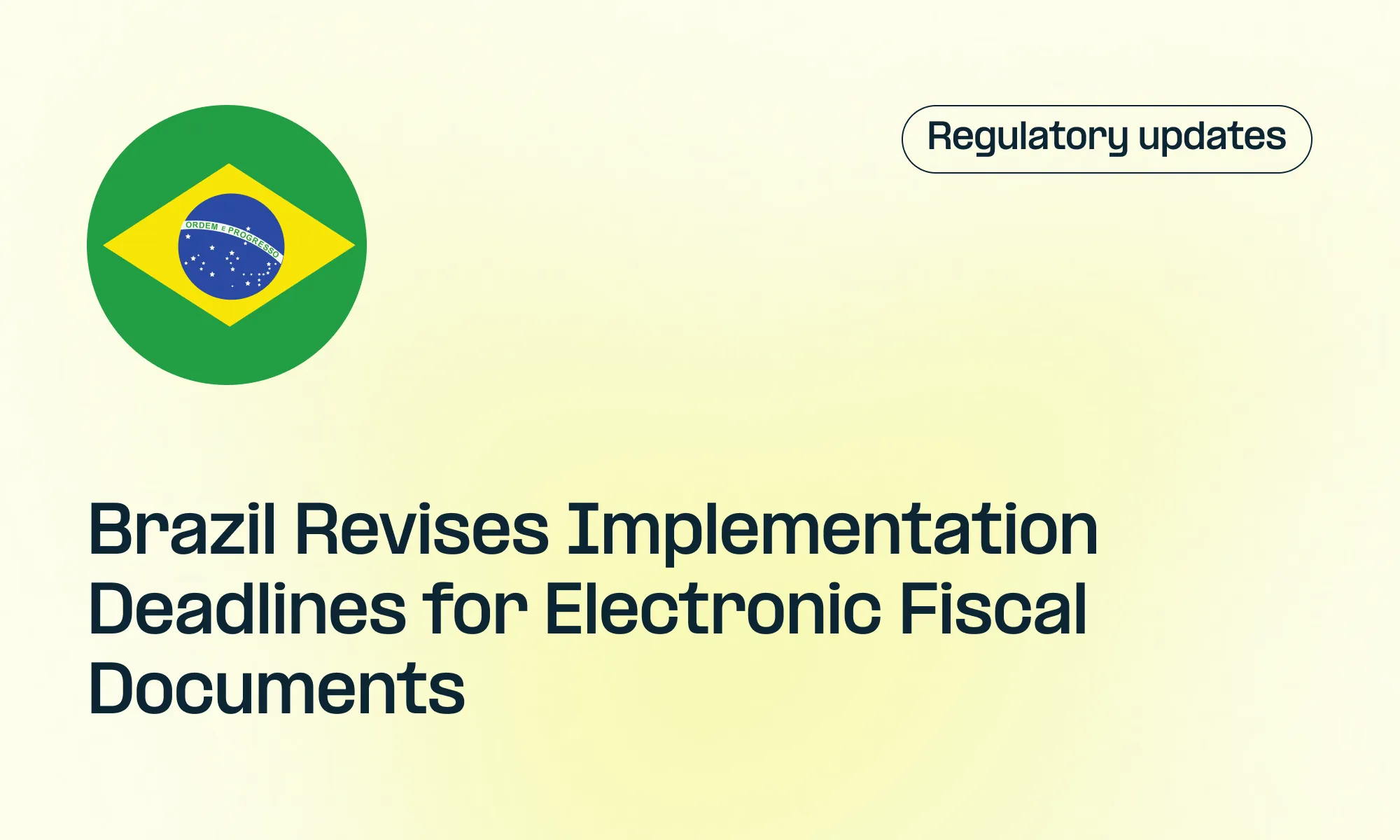

On 11 November 2026, Brazil's Federal Revenue Service (RFB) announced revised implementation deadlines for certain electronic fiscal documents under the country's consumption tax reform. The changes provide additional preparation time for affected businesses, including digital platforms, while maintaining the implementation of the broader reform from January 2027.
Brazil's revised electronic fiscal document implementation timeline
Originally scheduled for December 1, 2026, the requirements for electronic service invoices (NFS-e) covering digital platforms and certain digital services have been postponed to March 1, 2027.
Other revised deadlines apply depending on the document type, including January 1, 2027 for rentals and leases.
What the revised deadlines mean for businesses
Under the original timetable established by Joint Act RFB/CGIBS No. 4/2026, digital platforms and certain services intermediated through them were required to issue the applicable NFS-e with information on the new Goods and Services Tax (IBS) and Contribution on Goods and Services (CBS) from December 2026.
The revised implementation schedule affects the following electronic fiscal documents:
- December 15, 2026 and February 15, 2027: Second phase of implementation of the DeRE (Declaration of Specific Regimes), covering monthly digital tax reporting requirements for financial institutions.
- January 1, 2027: NFS-e requirements for rentals and leases, condominium revenues, intangible assets and other supplies, as well as electronic fiscal documentation relating to gas and water.
- March 1, 2027: Requirements for several additional electronic fiscal documents, including:
- NFS-e for digital platforms, data processing, software, internet content and municipal public transportation.
- BP-e TM and BP-e for air transport.
- DF-e for sales of goods under the Simples Nacional regime.
- NF-e ABI for real estate transactions.
The RFB also announced that the outstanding technical layout for electronic fiscal documentation relating to digital platforms is expected to be published in November 2026. Revised CBS regulations and complementary rules are also expected to be published in November and early December 2026, respectively.
For affected businesses, particularly digital platforms and digital service providers, the postponement offers additional time to adapt their invoicing systems to the new requirements. Businesses should review the forthcoming technical specifications, assess which document types and deadlines apply to their activities, and continue preparing for implementation.
The revised deadlines have been announced by the authorities, with the formal implementing rules still pending.