
Why traditional tax monitoring no longer works
When I was running international tax at Uber, our footprint went from 1 to roughly 60 international markets in less than 24 months.
Many of my mornings therefore started the same way. I'd open a dozen tabs: government gazette sites, paid subscription portals, industry newsletters, LinkedIn posts from people I trusted that would flag regulatory changes to the community. That last one was often the fastest source. Think about that for a second. A LinkedIn peer-to-peer channel. For staying compliant with the law and getting the latest news the fastest.
The newsletters were a special experience in their own right. I would scroll past pages of updates sorted alphabetically by country. So that meant going through everything from Angola to Venezuela, just to find the handful of markets I actually cared about.
Trying to spot something that looked relevant, sandwiched between articles about irrelevant topics and sectors like Oil and Gas tax incentives that had absolutely nothing to do with my business.
When I found something, I often had to click through to the advisor's website, land on a well written three-page article, and then spend another 10 minutes reading it just to figure out whether it actually impacted you. More often than not, it didn't really matter in the moment.
It wasn’t very sophisticated, but it was the only option available. And it was the standard.
Unfortunately, many years later, it still is.
Why traditional tax monitoring breaks at global scale
Every in-house tax team I've spoken to over the past decade has some version of this ritual. Scan, read, cross-reference, figure out if it matters, figure out if it matters to you, and then decide what to do about it. Multiply that by 50 or more countries, and it becomes clear this is no small feat.
And here's the thing about this process: most of the time, maybe not much changes that has catastrophic consequences. But when you miss the one that does, it's consequential! It can be costly, with penalties, back-assessments, blocked invoices, delayed market launches. It can have a huge operational impact on the business.
And on top, it's embarrassing to miss an update. As a tax team, you have one job: make sure you're on top of the rules and regulations that govern your business.
Knowing before your local teams or others in the company do is what you get paid to do. I always felt that getting blindsided by a change I should have caught was painful. It's the kind of thing that erodes trust with leadership fast.
This challenge of non-stop staying up to date is a problem everyone in tax with a large enough geographical footprint recognizes. And needless to say, one that has frustrated me for years. We wanted to solve it.
The three jobs every modern tax team needs to perform
Before we get into the solution to the tax monitoring challenges teams face now, consider the broader purpose of a tax team. There are three basic priorities:
1. Know what’s important
Know is the intelligence layer. Understanding what the rules are, what just changed, what's coming, and what it means for your specific business.
2. Act on what matters
Act is the execution layer, the platform that applies those rules to your transactions autonomously, in real time.
3. Prove everything
Prove is the assurance layer, that is to say, the ability to demonstrate to auditors, tax authorities, and your own leadership that every decision is traceable and defensible.
Why today's tax technology only solves part of the problem
Today’s tax technology market is mainly focused on the execution layer: tax engines, compliance software, and e-invoicing.
And that's where Fonoa started, too. It is critical. And it requires an integrated, connected approach across the transaction lifecycle. Not the standalone point solutions for each step that is still the industry standard. Over the last 7 years, we've built that single-core platform with a global footprint, something we're proud of.
But for tax teams, execution is just a part of the equation.
Without solving the “Know” layer to stay ahead on what is coming, it is hard to anticipate change, resources and automation needs. You can automate perfectly and still get it wrong if the rules you're working from are outdated or incomplete.
Why AI-powered tax intelligence is harder than it looks
It’s worth saying outright: The idea of an AI-powered regulatory intelligence tool is obvious. Everyone can see the problem. Plenty of large enterprise tax teams we work with have tried to build this themselves internally. Some of the most sophisticated, best-resourced tax functions in the world have taken a run at it. And they've all hit the same challenges.
The first wall is sources. Tax law doesn't live in one place. It's scattered across thousands of government portals, legal databases, official gazettes, ministry announcements, and court rulings—in dozens of languages, published in inconsistent formats, often without any structured metadata. Finding all the primary sources and keeping them current is an infrastructure challenge on its own.
The second wall is AI accuracy. Getting a large language model to summarize a tax development is easy. Getting it to do it consistently at the highest accuracy without hallucinating is a completely different challenge. In tax, a hallucination is a compliance risk. Every output needs to be grounded in primary legislation, with accurate citations that you can actually verify.
The third wall is relevance. The world produces an enormous volume of regulatory change. Most of it doesn't apply to you. The hard part is filtering with precision, surfacing everything that matters to your business profile while cutting the noise.
Miss something relevant and you have a gap.
Surface too much and nobody reads it.
It's a fine line, and getting it right requires a deep understanding of both the regulatory content and the business context.
We've been working on perfecting this full steam behind the scenes for close to 12 months. And boy has it been a resource-intensive effort.
Introducing Fonoa Knowledge
Today, we're bringing Fonoa Knowledge to market.
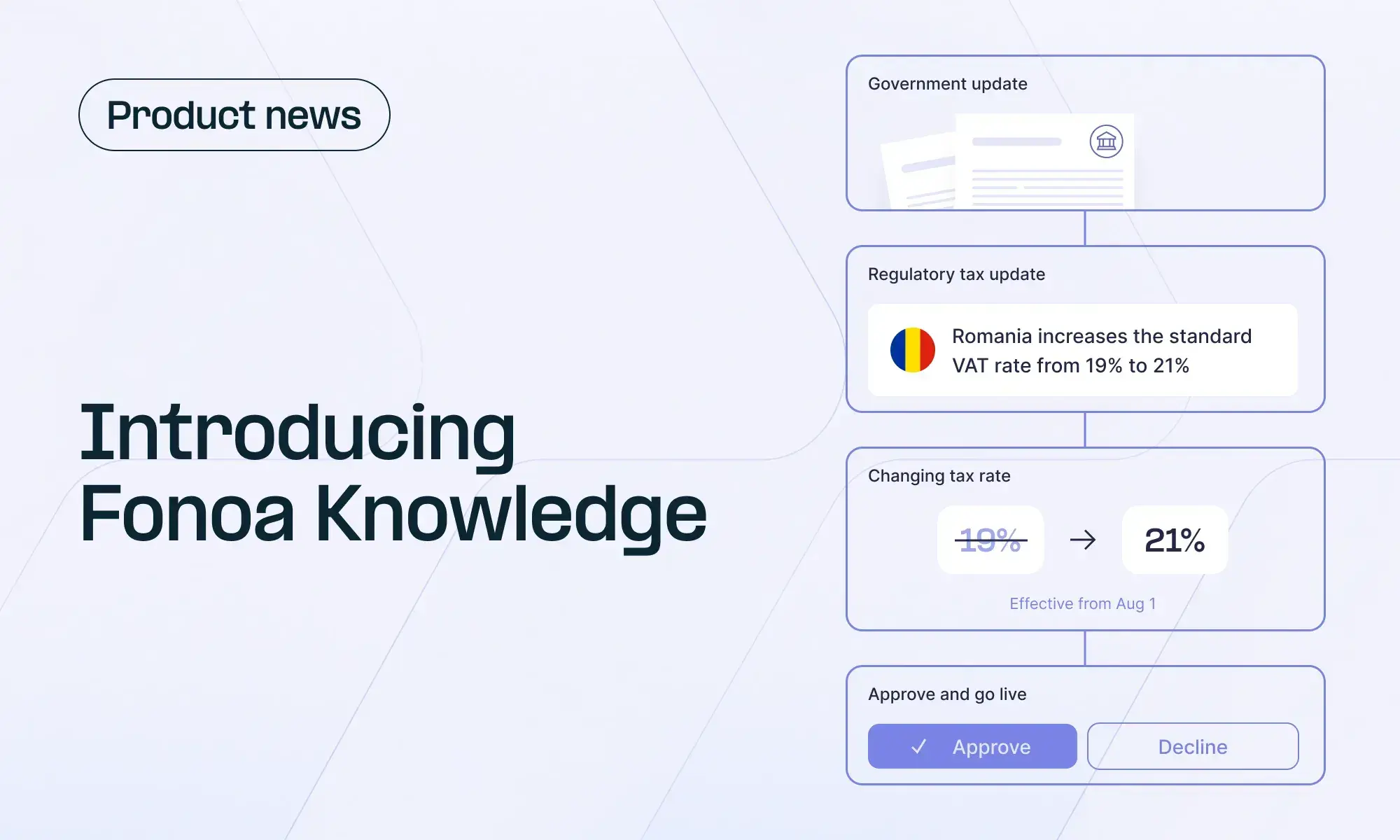
Knowledge is our AI-powered regulatory intelligence product. It monitors global indirect tax changes continuously, maps them to your specific company profile, and delivers cited, actionable insights, cutting out the noise. Every answer is grounded in primary sources. Every citation is verifiable. And because Knowledge sits on top of the same platform that runs your tax calculations, e-invoicing, and returns, turning intelligence into action is not a separate workflow. It's the same system.
We've been developing this with some of the largest enterprise tax teams in the world as design partners, companies operating across dozens of markets who gave us direct, unfiltered feedback on what actually matters in their daily workflows. Companies that because of their size, are extremely cautious on quality and accuracy of content. That input has been invaluable. It shaped everything from how we rank materiality to how we route alerts to the right person at the right time.
For the first time, tax teams don't have to choose between breadth and accuracy. Between automation and control. Between knowing what changed and knowing what to do about it.
We're building something that I wish existed when I was the one juggling those Linkedin groups and browser tabs at 7am. And we're just getting started.
If you want to see it, get in touch.






.jpg)