
Autonomous compliance is not a single product or a futuristic ambition. It's a new operating model for how businesses maintain integrity and control in an increasingly digital world. It's a system that builds trust and keeps control at every level, from the quality of data that enters it to the intelligence that interprets it, to the automation that acts on it, and finally, to the human oversight that ensures it remains accountable.
Imagine the new architecture as a precision-crafted layer cake. Data provides the foundational tier. Intelligence adds a nuanced middle layer that interprets flavor and structure. Adaptive execution serves as the refined outer layer that responds to every context. And human governance is the master pâtissier—bringing judgment, oversight, and balance. The interplay of these layers creates a self-reinforcing cycle of confidence, learning, and control.
Layer 1: Unified data eliminates the root cause of compliance errors
Trust in compliance begins with trust in data. Every calculation, filing, and decision depends on the integrity of the information flowing through the system.
The data fabric provides that foundation by creating a single, unified layer that connects every tax-relevant data source (ERP, procurement, billing, e-commerce, and financial platforms) and data event (master data creation, tax calculation, digital reporting, filing) into one consistent transactional framework.
This is not just about centralization. The data fabric standardizes and enriches transactions in real time, embedding the business context necessary to make tax decisions accurate and explainable. Each transaction is validated at the point of creation, ensuring completeness. By the time it reaches the compliance steps (real-time reporting and periodic returns), the data is already validated, reducing the need for downstream reconciliation or manual manipulation.
For a CFO, this translates into measurable risk reduction. The data fabric eliminates duplicate effort and human error by ensuring that every part of the compliance lifecycle begins with the same, verified truth. Bad data no longer cascade through systems, and the tax function gains a foundation strong enough to support automation that can actually be trusted.
Layer 2: AI that learns from your business and predicts issues before they happen
If the data fabric establishes trust in the inputs, the intelligence layer builds trust in the reasoning. This is where automation evolves from efficiency to cognition.
The intelligence layer is an AI-driven engine that continuously learns from transactions, filings, feedback, and regulatory updates to improve its understanding of both global tax frameworks and company-specific behavior.
It combines structured global tax knowledge (rates, thresholds, rules, and schemas) with localized context about how a business actually operates. Over time, it learns which exceptions are intentional, which are emerging risks, and which are genuine anomalies. It identifies new patterns in data that could indicate a process issue, a regulatory change, or even potential fraud. It acquires the institutional knowledge of even the most senior members of the tax team.
For the CFO, this is where compliance becomes predictive rather than reactive. Instead of discovering issues after a filing deadline or audit inquiry, the system alerts decision-makers to anomalies and trends as they develop.
It doesn't just say that something is wrong. It explains why, quantifies the exposure, and suggests corrective actions based on historical outcomes and materiality thresholds.
The Head of Tax or CFO doesn’t see a list of errors but a set of insights, each with a confidence score, a quantified risk, and a clear path to resolution. The tax team can validate the proposed adjustments and approve their implementation directly from the platform. Once confirmed, the intelligence layer updates its models so that future transactions reflect the corrected logic automatically.
What's critical is that the system does not merely report what went wrong. It explains why it happened, how much it matters, and how to prevent it from recurring. Each feedback loop strengthens the intelligence of the platform, and each correction becomes part of the company's operational memory.
Compliance moves from hindsight to foresight. The business no longer waits for audit findings or regulator inquiries to reveal problems. The intelligence layer continuously interprets the organization's data in light of evolving rules and real-world behavior, delivering early warnings, recommended actions, and measurable confidence in every filing.
Layer 3: Adaptive execution improves with every transaction
The adaptive execution layer is where intelligence becomes performance. It's the operational core of autonomous compliance: the part of the system that applies tax rules, issues invoices, reconciles data, and submits filings with minimal human intervention.
Unlike static automation, adaptive execution doesn't simply repeat the same process. It improves with every cycle. It incorporates lessons from rejections, authority feedback, and human interventions, continuously adjusting its logic and confidence models. Over time, it becomes increasingly self-sufficient, handling known patterns automatically and routing only unfamiliar or material exceptions for review.
For the CFO, this is where transformation becomes measurable. Expansion into new jurisdictions no longer demands new integrations, manual filings, or armies of people chasing errors. The same intelligent system that calculates tax also issues compliant invoices and files digital reports, continuously, transparently, and with confidence.
Compliance cycle times shrink, accuracy improves, and headcount growth flattens even as obligations multiply. The organization moves beyond the old model of "more people fixing problems" to a smarter one: "fewer people preventing them."
The system no longer needs to be told what to do in each country. It knows. It understands the intent behind each transaction, applies the correct treatment, issues compliant invoices, and reports them to authorities, all while maintaining a transparent, traceable record of every action it takes.
This is how autonomous compliance moves from theory to practice: not through replacing humans with machines, but through building a system that acts, learns, and explains itself at every step.
That is the moment when compliance stops being an obligation and becomes an operational advantage.
Layer 4: Human oversight shifts from managing tasks to governing outcomes
Even in a world of autonomous compliance, humans remain at the center of trust. The human governance layer defines the boundaries within which automation operates and ensures accountability for every decision the system makes.
Rather than intervening in every process, tax and finance teams monitor the system's performance through a governance dashboard that offers a real-time view of compliance health. From a single screen, the CFO and tax leaders can see:
- Status of compliance across all jurisdictions, including filings submitted, validations completed, and outstanding actions
- Trend analysis showing how automation confidence, rejection rates, and correction volumes evolve over time
- Exception summaries that quantify exposure, flag emerging risks, and show which items required human review
- Audit trail visibility that provides a complete lineage of decisions, data sources, and authority submissions
Every automated action and every human intervention is logged, explained, and traceable. When regulators change schemas or new mandates appear, the system highlights the impact, simulates outcomes, and routes only material updates for approval. Each confirmation or correction becomes new learning data, strengthening both automation and assurance.
For the CFO, this represents a new model of control. Control, not through more management, but through better visibility. The organization retains full accountability while reducing manual dependence. Compliance confidence is quantifiable, oversight is data-driven, and governance moves from reactive to predictive.
In this model, automation and accountability are not opposing forces. They are complementary drivers of trust. Humans no longer manage compliance; they govern it, ensuring that as the system runs faster, it also runs smarter, safer, and always in alignment with the organization's intent.
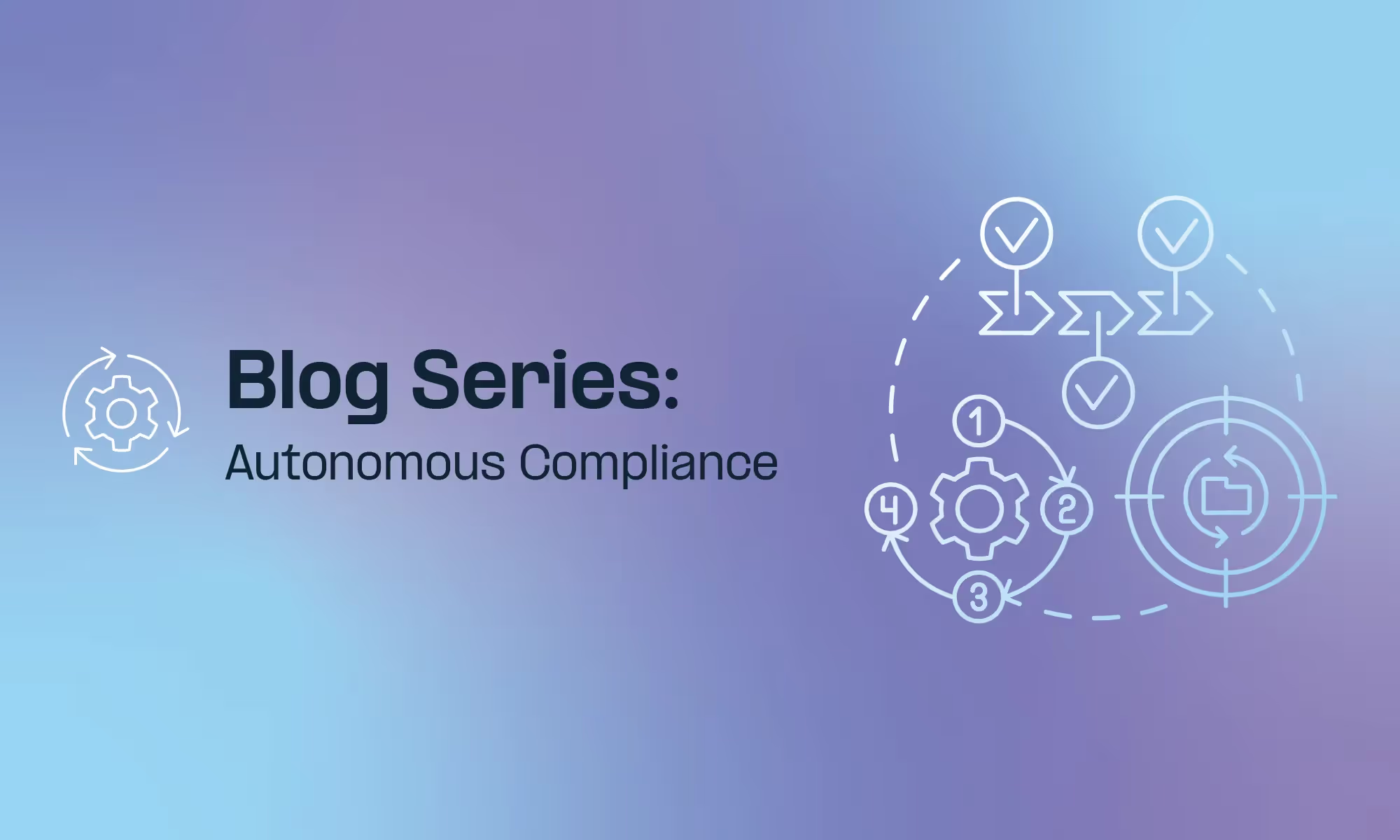
Four layers working together create a self-reinforcing system of trust
When these four layers work in concert, compliance transforms from a function of control into an ecosystem of confidence.
The data fabric provides integrity at the source. The intelligence layer adds understanding and foresight. The adaptive execution layer delivers precision and scalability. And the human governance layer safeguards accountability and transparency.
This is not a vision of replacing people with algorithms. It's a vision of equipping people with systems that make compliance invisible until it truly needs attention. It is a future where compliance is not a constraint on growth but an enabler of it. A quiet, intelligent guardian that keeps the organization confident, compliant, and ready for whatever comes next.
Fonoa's platform unifies data, intelligence, and execution in one ecosystem
Fonoa is building the first AI-powered compliance platform: a consolidated set of solutions, supported by a single data and intelligence layer, designed to maintain control by earning trust.
It unifies data, applies intelligence, and explains every action. It connects the full lifecycle, from tax calculation to filing, in one ecosystem. It's built to be transparent, auditable, and continuously learning.
The future of compliance isn't about replacing people. It's about giving them a system they can trust to think like them, act faster, and never sleep.
Tax authorities are moving in real time. AI is ready. The data is there. The only thing missing is the decision to trust it.
Ready to see how this works for your organization? Request a demo to explore how Fonoa's autonomous compliance platform can transform your tax operations.

.avif)