
The United Nations just released its 2025 Guidance Paper Series on VAT/GST. It's packed with policy recommendations, but one theme stood out: identity is everything.
We're moving past the era of manual checks and casual assurances of registration status. The UN is explicitly recommending tax ID verification controls at multiple touchpoints throughout the indirect tax lifecycle. From the moment a taxpayer registers to the millisecond a transaction occurs across borders, the expectation is shifting toward real-time, continuous validation.
For tax teams and ERP specialists, validation tools are moving from optional to table stakes. Here's what the UN is actually saying about tax ID validation and why it matters for businesses operating across borders.
7 key takeaways from the UN's guidance
The guidance spans multiple papers covering VAT/GST administration, refunds, small enterprises, and the use of technology in compliance. Throughout, the message to tax administrations is consistent: tighten controls around tax ID verification. For businesses, that means the bar for what counts as adequate validation is rising. Here's what stands out.
1. Verification is no longer a one-time event
The guidance is clear: "It is recommended that regular monitoring of the VAT register is undertaken to... [identify] registrants who no longer meet the requirements."
Businesses change. They close, pivot, merge, or lose their VAT registration for any number of reasons. A tax ID that was valid when you onboarded a customer six months ago might not be valid today. The UN is advising that checking tax IDs must be a continuous process of monitoring and cleaning data. Not just a gatekeeping task at the point of sale.
This has real implications for how companies structure their compliance workflows. If you're only validating at customer onboarding, you're building on a foundation that degrades over time. In fact, up to 14% of tax IDs can change in a single year, which is why companies like Amazon, Twilio, and Remote have built revalidation into their operational DNA.
2. Algorithmic validation is the expected baseline
The UN recommends that tax administrations build check-digit validation directly into their IT infrastructure.
The guidance cites the need for "validating TINs with check digits, linking associated entities with related parties, mitigating the risk of duplicate or conflicting records."
What does this mean for businesses? Expect tax authorities to increasingly reject invalid formats before they ever enter the system. If governments are expected to implement algorithmic checks, companies should be doing the same on their end. Catching formatting errors before they create downstream compliance issues. Check digits are the first line of defense, but they're just the starting point.
3. APIs are the answer for cross-border verification
For digital businesses operating internationally, knowing whether a customer is B2B or B2C in real-time is fundamental to determining tax treatment. The guidance acknowledges this directly: "customer tax status verification... can be difficult if there are issues with the integrity of taxpayer registers or challenges with deployment of technology such as application programming interfaces (APIs) for real time verification."
The UN is pointing to APIs as the solution. Not batch processing. Not periodic manual checks. Real-time verification at the moment of transaction. This aligns with the broader trend toward continuous transaction controls that we're seeing in tax administrations worldwide.
4. Tax ID validation determines where tax is due
This one is worth emphasizing. Validating a customer's tax ID isn't just about compliance hygiene. It determines the entire tax treatment of a transaction.
As the guidance notes: "In a cross-border situation, the name and VAT number of the customer are needed to determine whether VAT is due in the jurisdiction of the supplier."
Get the tax ID wrong or fail to validate it, and you may be applying the wrong tax rate entirely. For businesses selling across borders, this isn't a minor data quality issue. It's a fundamental input to your tax calculation logic.
5. Fraud prevention starts at registration
The UN recommends "requiring proof of identity checks for VAT registration to prevent fictitious traders from accessing the VAT system."
This is aimed at tax administrations, but it has implications for businesses too. As governments tighten registration controls to prevent refund fraud, companies need to be confident that the tax IDs they're accepting belong to legitimate, currently registered entities. Not to fraudsters who slipped through earlier, looser controls.
6. No valid tax ID means no valid invoice
The guidance reiterates what many tax professionals already know: a tax ID is a non-negotiable element of a valid invoice.
"At the minimum, it should contain the supplier's taxpayer identification number, name and address... the value of the goods and services, the VAT applicable... and a date."
No valid tax ID, no valid invoice. No valid invoice, no input tax credit for your customer. This makes tax ID validation not just your compliance concern. It affects your customers' ability to recover VAT on their end.
7. Pre-verification is becoming the standard
The guidance highlights systems where input tax credits are only allowed if the underlying invoice and tax IDs have been pre-verified. Pakistan's FASTER system gets a specific mention:
"The system guarantees that buyers only claim valid input tax credit... based on a pre-verified sales tax invoice verification system... thus linking a whole supply chain of VAT regime."
This is the direction of travel. Rather than auditing after the fact, tax authorities are building systems that prevent invalid credits from being claimed in the first place. Businesses that can demonstrate pre-verified, clean data will be better positioned as these systems become more widespread.
What this guidance means for tax teams
The 2025 UN Guidance makes the trajectory clear. Stricter tax ID controls are becoming the global standard. Algorithmic checks, real-time APIs, identity verification at registration, pre-verification for input credits. Together, these represent a comprehensive framework for tax ID validation throughout the tax lifecycle.
For tax teams, the question isn't whether to invest in validation capabilities. It's whether your current approach can keep pace with where regulations are heading.
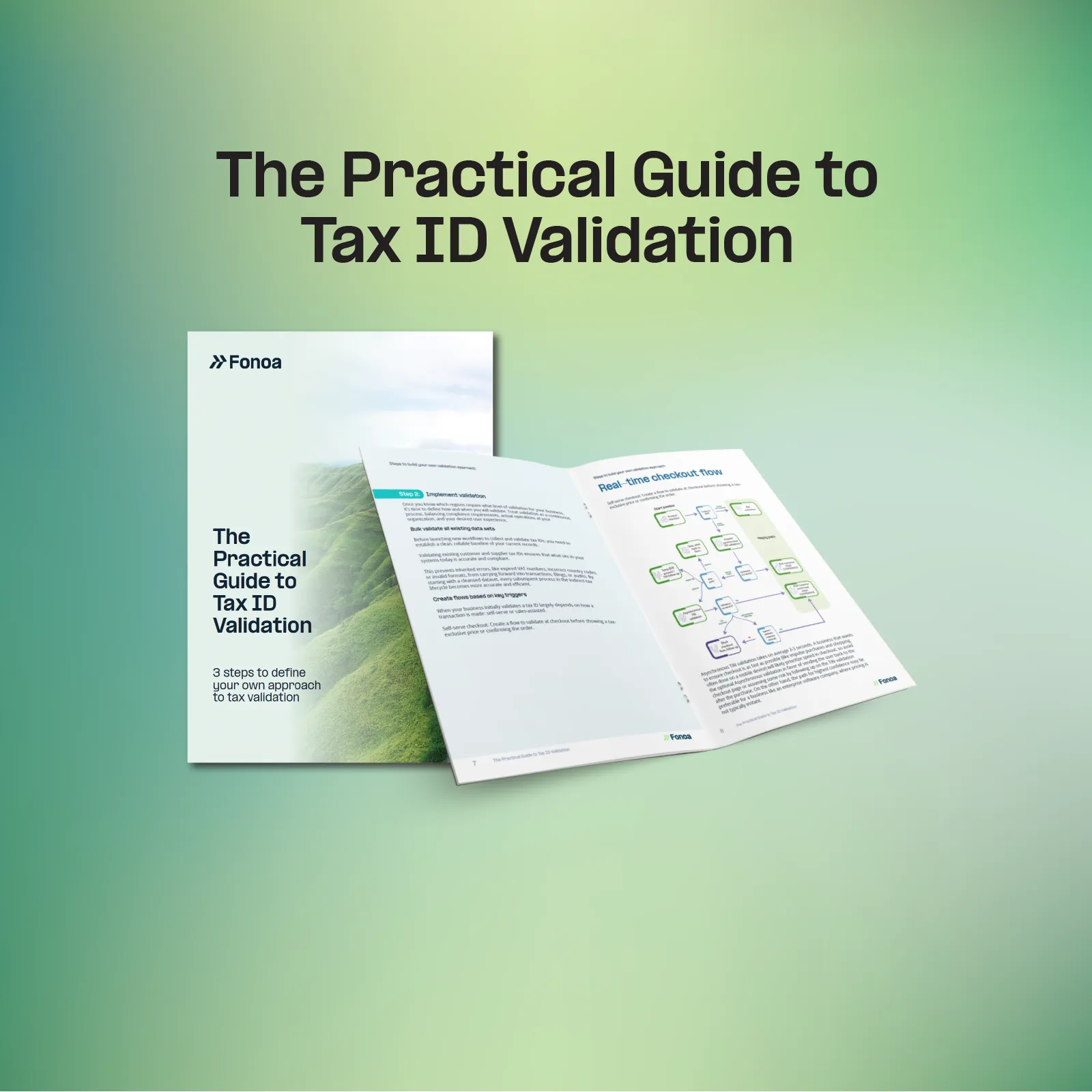
Ready to build a validation strategy that meets the moment? Download The Practical Guide to Tax ID Validation for a framework covering where to validate, how to capture evidence, and when to revalidate.






.jpg)