

Brazil is running out of business tax IDs. With over 60 million tax IDs or “CNPJs” already issued and the available pool of numeric-only combinations capped at roughly 100 million, the current system is hitting its limit.
To keep the economy open for business, the Receita Federal (Brazil's Federal Revenue Service) has announced a major upgrade:
Starting in July 2026, the Brazilian business tax ID (Cadastro Nacional da Pessoa Jurídica or CNPJ) will switch to an alphanumeric format.
Here’s what your tax team needs to know to stay compliant.
The new format for Brazil’s tax IDs
The familiar 14-digit length of the CNPJ remains the same, but the composition is getting a significant makeover to drastically expand capacity.
- Current Format: NN.NNN.NNN/NNNN-NN (Strictly numeric)
- New Format: SS.SSS.SSS/SSSS-NN (Alphanumeric)
The breakdown:
- The Root (First 8 positions): Can now include both letters and numbers.
- The Order (Next 4 positions): Can now include both letters and numbers.
- The Check Digits (Last 2 positions): Will remain strictly numeric.
Crucially, the validation logic (the "Modulo 11" algorithm) remains largely unchanged, but the character mapping has been updated to assign numerical values to letters (e.g., A=17, B=18) for calculation purposes.
Brazil has outgrown its numbering system
Why? Volume. The scale of Brazil’s entrepreneurial growth has exceeded what its numbering system was designed to handle.
By allowing letters in the first 12 positions, the number of possible unique IDs jumps from millions to trillions. This "future-proofs" the system for centuries, ensuring that new businesses—from tech startups to local bakeries—can continue to register without hitting a systemic wall.
Technical specifications available now
For developers, tax technology teams, and finance teams, the Receita Federal and ENCAT have released detailed specifications to help you prepare your ERPs and e-invoicing solutions.
- The legal basis: Instrução Normativa RFB Nº 2.229 (October 15, 2024)
- This is the official regulation establishing the new alphanumeric format.
- The technical specs: Nota Técnica Conjunta 2025.001
- This document contains the validation rules, ASCII character mapping tables, and XSD schema updates.
The good news? Existing companies don’t need to change their numbers. This only applies to new registrations starting mid-2026. But for your systems, the future is already here.
Three steps to prepare for alphanumeric CNPJs
1. Audit your systems
Identify every touchpoint where CNPJs are entered, validated, or stored. Look for hardcoded numeric-only validation rules, database fields with numeric-only constraints, and UI elements that might reject letters. This is often more widespread than teams initially expect.
2. Update your validation logic
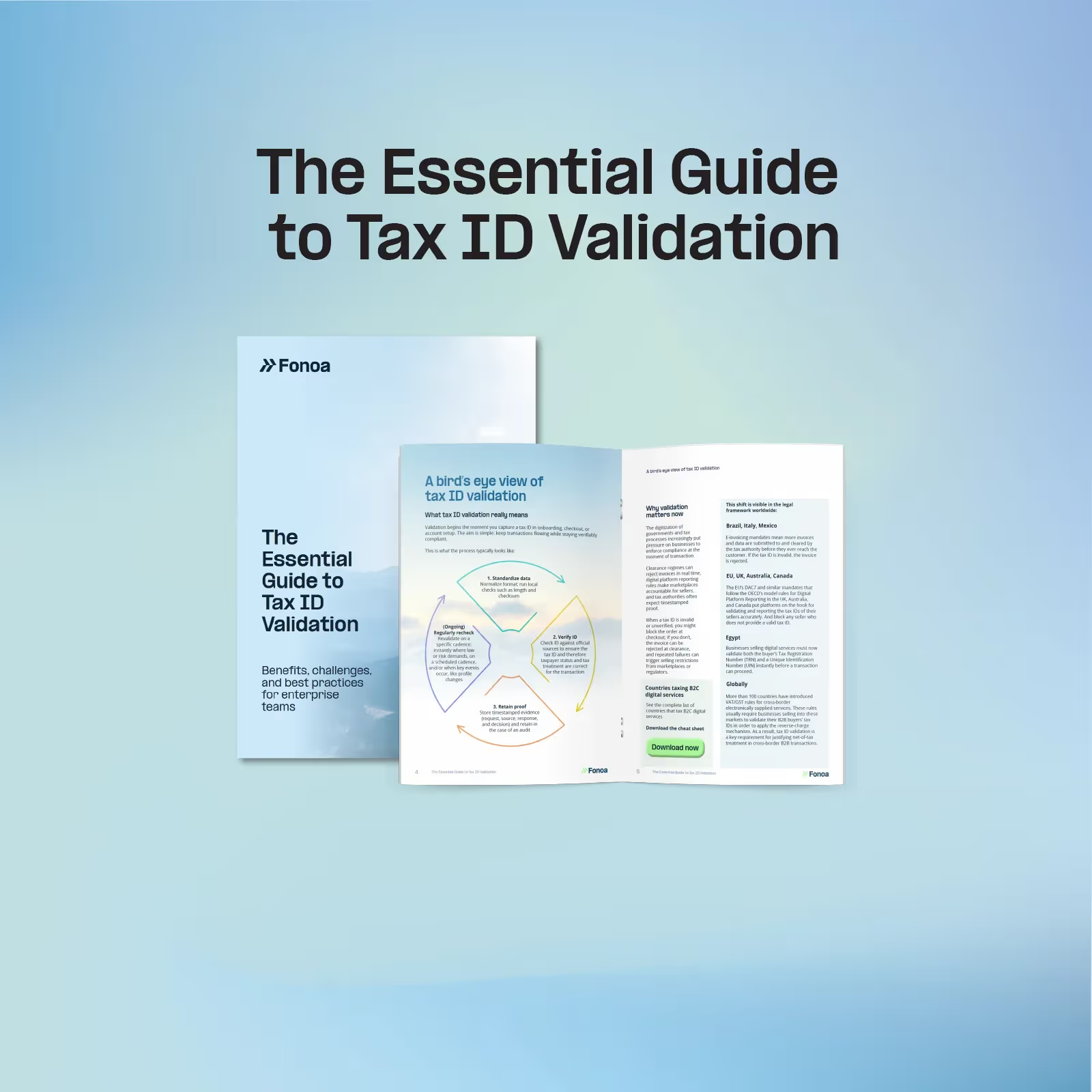
Format checking alone isn't enough. True validation means verifying the CNPJ exists and valid in the official Brazilian records. Fonoa's tax ID validation handles both format verification and real-time database checks for CNPJs (and CPFs - personal tax IDs), automatically adapting as Brazil's format evolves.
3. Coordinate with your e-invoicing providers
Brazil's e-invoicing mandate means every invoice must correctly reference valid tax IDs. If your e-invoicing system can't process alphanumeric CNPJs, you'll hit rejections starting July 2026. Don't wait until the first new-format CNPJ lands in your inbox to discover a gap.
This CNPJ update arrives alongside broader changes to Brazil's e-invoicing infrastructure, including the nationwide rollout of the new NF-e standard. Both changes require system updates, which makes now a good time to review your entire Brazilian tax compliance stack.
Getting ahead of regulatory changes
Brazil's CNPJ update is a reminder that tax administration is constantly evolving. New formats, new mandates, new filing requirements appear regularly across jurisdictions. The teams that handle these transitions smoothly are the ones who build flexibility into their systems from the start.
Rather than custom-building validation logic for every tax ID format in every country, finance teams that use platforms to stay current automatically can keep validations accurate without adding more manual work. When Brazil updates its CNPJ format or any other country changes its tax ID rules, the validation just works without manual intervention.
That's the difference between reacting to regulatory changes and being ready for them.
Want to see how Fonoa handles tax ID validation across 110+ countries, including the new Brazilian CNPJ format? Get in touch with our team.