
Brazil's consumption tax reform brings new electronic invoicing and reporting requirements for digital services and platforms, with an important implementation milestone on December 1, 2026.
In our recent webinar, the number one question we got was about foreign supplier regulations under Brazil’s consumption tax reform. Attendees wanted to know whether non-resident SaaS and digital service providers are in scope, whether it applies from 1 December, and what the regulations confirm. Several pointed out that some providers in the market say non-residents are not subject to e-invoicing at all.
This post answers those questions in full. The short version is that the legislation already establishes several of these responsibilities, including rules for direct imports, foreign suppliers and digital platforms. However, aspects of the practical implementation remain unresolved, particularly the registration and invoicing procedures for nonresidents without a Brazilian establishment.
What changes for Brazil e-invoicing on December 1, 2026?
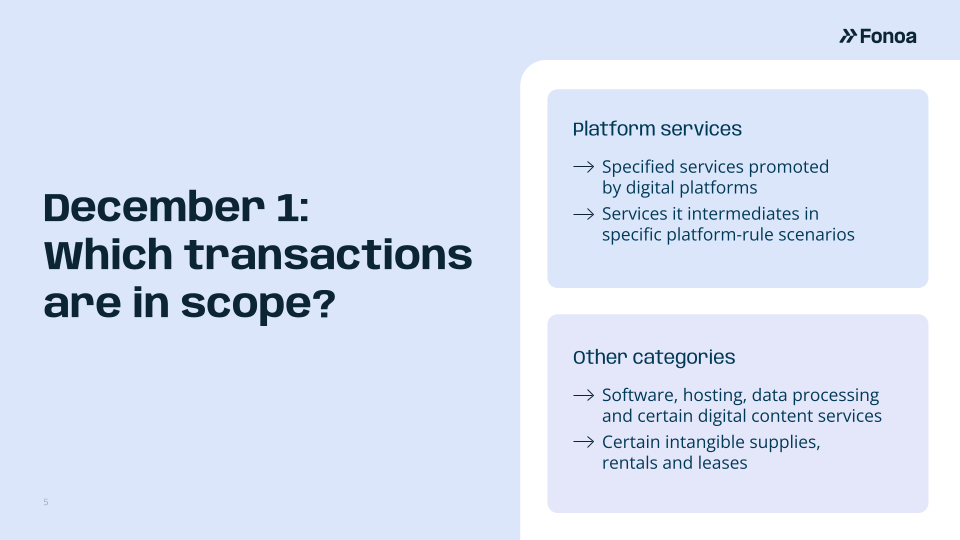
On December 1, 2026, specified services and platform transactions move into the new NFS-e and IBS/CBS fiscal-document timetable. It is a document and reporting milestone. It does not start full-rate IBS/CBS collection, which follows the wider reform schedule: CBS replaces PIS/COFINS in 2027, and IBS replaces ICMS and ISS in a transition from 2029 to 2033.

The December scope covers software, hosting, data processing and certain digital content services, along with platform services, certain intangible supplies, rentals and leases. Brazil is moving toward destination-based taxation, so the IBS/CBS import rules can apply to services consumed in Brazil even when the supplier, the contract and the servers are abroad.
Who is responsible for e-invoicing and IBS/CBS in Brazil?
Two questions sit under every transaction. Who must issue the electronic fiscal document? And who is responsible for IBS and CBS?

The answers depend on who supplies the service, whether a platform intermediates the transaction, and where the underlying supplier is established. Three scenarios cover most businesses.
How do Brazil's e-invoicing rules apply to different business models?
The responsibility for issuing fiscal documents and paying IBS/CBS depends on the business model and the parties involved.
Scenario 1: Foreign SaaS and digital service providers selling directly to Brazil
This scenario has no intermediary. Take a US software company that sells subscriptions directly to Brazilian customers.
Specified services from Complementary Law 116/2003 are covered: data processing and hosting (1.03), software licensing (1.05) and defined online content (1.09). There is no blanket B2B exclusion, so business customers do not take a supplier out of scope.
When a Brazilian customer purchases software or digital services directly from a foreign supplier, the Brazilian customer is generally responsible for IBS/CBS as the taxpayer. If a foreign company purchases the service for a recipient in Brazil, the Brazilian recipient becomes the taxpayer instead. In both cases, the foreign supplier is jointly liable for IBS/CBS under Brazil’s import rules, subject to the applicable registration and collection provisions.
Covered services fall within the applicable Brazilian fiscal-document requirements. However, this does not automatically establish that every foreign supplier must self-issue an NFS-e. The applicable issuer and nonresident issuance process needs to be determined. The registration section below covers what is confirmed and open for direct suppliers.
Scenario 2: Digital platforms intermediating foreign suppliers
Take a marketplace that facilitates the sale of digital content from a US creator to a Brazilian customer.
A business counts as a digital platform when it intermediates a remote or electronic transaction and controls at least one essential element: billing, payment, terms or delivery.
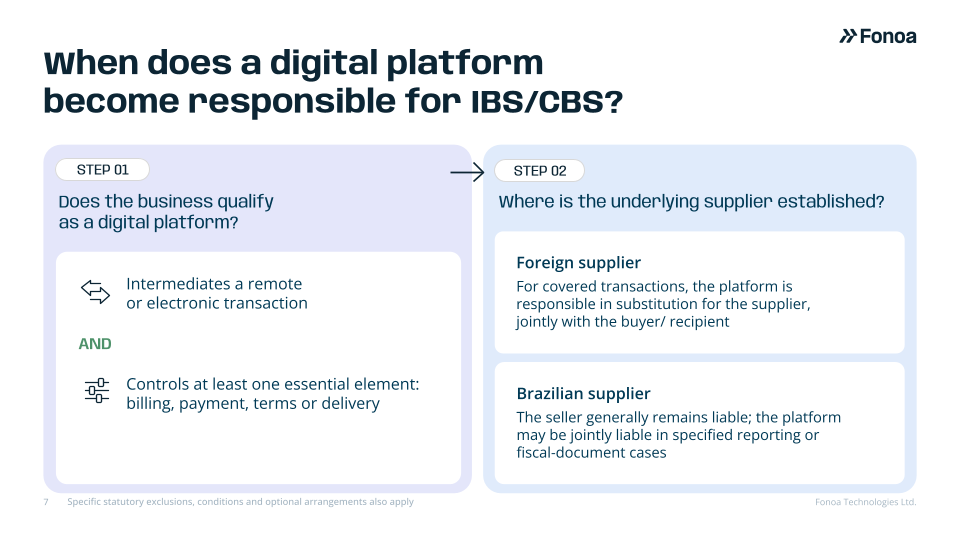
For covered imports, a qualifying platform becomes responsible for IBS/CBS in substitution for the foreign supplier, jointly with the Brazilian buyer or recipient. The relevant transaction must follow the applicable fiscal-document rules. Qualifying foreign platforms must also register under the regular IBS/CBS regime, which the registration section below covers.
Scenario 3: Digital platforms intermediating Brazilian suppliers
Take an online marketplace that connects Brazilian sellers with customers.
The Brazilian seller generally remains responsible. The platform may become jointly liable in specified cases, including failures involving transaction reporting or required fiscal documents.
With the seller’s consent, a platform may issue documents in the seller’s name and pay IBS/CBS, or elect to act as tax substitute, issuing documents and calculating and paying the taxes.
Where a Brazilian seller fails to issue a required fiscal document, a platform may issue it within 30 days of the seller's original deadline and pay the applicable IBS/CBS. In such case, the late-payment charges and non-issuance penalty are imposed exclusively on the seller.
Do foreign suppliers need a CNPJ to comply with Brazil's e-invoicing rules?

Brazilian legislation establishes IBS/CBS registration obligations for nonresident suppliers and digital platforms. A foreign supplier may be required to register as a taxpayer for operations located in Brazil or as a tax-responsible party for imports, subject to statutory exemptions. Foreign suppliers operating exclusively through a properly registered platform can qualify for relief from separate registration.
In terms of the technical and implementation details, the technical timetable has not progressed uniformly. Brazil initially scheduled publication of the dedicated NFS-e specifications for digital platforms for 1 September 2026, but the official implementation timetable has not confirmed that milestone as completed. Separately, updated NFS-e technical documentation has been published, including new requirements for cross-border transactions.
Businesses should distinguish between published general NFS-e specifications and the still-unconfirmed operational requirements for specific platform and nonresident issuance scenarios.
Five steps to prepare for Brazil's e-invoicing requirements
The right answer differs by business model, so we recommend working through the flow in order.
- Confirm the supply and business model. Identify what you supply, whether Brazil consumes it, and whether you sell directly, intermediate third-party sales, or do both.
- Identify the parties and tax responsibilities. For direct foreign supplies, the Brazilian acquirer is generally the taxpayer and the foreign supplier is jointly liable. For platform transactions, the foreign-seller and Brazilian-seller rules above apply.
- Confirm registration and issuing access. Establish which entities need IBS/CBS registration and a CNPJ, whether any exemptions apply, and which credentials and permissions the invoicing system requires.
- Define the invoicing and reporting route. Determine who issues the fiscal document and through which system. For Brazilian sellers, separate seller-issued documents from arrangements where platforms issue on the seller's behalf, and include any platform transaction-reporting obligations.
- Prepare the data and test. Collect supplier and customer identifiers, Brazilian destination information, service classifications, IBS/CBS details and payment references, then test issuing, validation and reporting against the published specifications.
What to do while the guidance catches up
Guidance on nonresident registration and issuing is still arriving, and technical changes can take months to implement. The practical move is to start with what the rules already settle. Map your transaction flows, work out who carries the invoicing and tax responsibility in each, and test against the published NFS-e requirements. Keep the non-resident items flexible until the authorities confirm them.

To see how Fonoa can support your compliance in Brazil and beyond, explore Fonoa e-invoicing.
Please note: This is a high-level compliance overview and does not constitute legal or tax advice. Requirements can differ by transaction, municipality, taxpayer status and implementation guidance.
FAQs about Brazil e-invoicing for foreign suppliers
Do foreign SaaS providers need to issue an NFS-e from December 1, 2026?
No. The transaction may be in scope, but the Brazilian taxpayer, the foreign supplier's joint liability, registration and the document issuer all need to be determined for the specific flow.
Are B2B transactions excluded from Brazil's e-invoicing requirements?
No. Customer status affects the mechanics and credits, but there is no blanket B2B exclusion from the import or platform rules.
Must a foreign supplier establish a Brazilian subsidiary?
Not automatically. A CNPJ-based registration can apply without local incorporation, although representation and onboarding requirements may apply.
If a platform is involved, does it always issue the NFS-e?
No. A platform may owe IBS/CBS without being the supplier or the invoice issuer. Brazilian sellers normally issue unless a specific seller-on-behalf-of route is used.
Is Brazil's e-invoicing compliance mandatory during the 2026 transition?
Compliance is not optional. During 2026, IBS and CBS operate under transitional test rates of 0.1% and 0.9%, respectively. Subject to compliance with the applicable obligations, taxpayers may be exempt from paying those amounts. Brazil has also introduced a compliance programme focused on correcting implementation issues during the transition.
These measures do not automatically eliminate fiscal-document obligations or postpone the published deadlines. Plan for December 1, 2026 and keep monitoring guidance.