State of Indirect Tax in the AI Era 2026
New research from 176 indirect tax leaders on where AI in tax actually stands, what's blocking production, and what the organizations seeing results have built differently.

Leadership wants AI. The mandate is real. But ask what AI is actually doing for the tax function, what it's automated, what return it's produced, what decisions it can defend, and the answers get thin fast. That gap is what this report measures.
AI adoption: why 92% adoption isn't the metric that matters
92% of tax functions are using AI in some form. Most can't measure what it's doing, govern how it works, or defend the decisions it makes. The small cohort that has closed that gap is seeing compliance workload decrease at 8x the rate of everyone else. This isn't a report about whether tax teams are adopting AI. They are. It's about what separates the teams getting results from the teams getting noise.
The AI mandate is real, but what leaders want is unclear
Nearly nine in ten tax functions are under leadership pressure to adopt AI. Almost none have been told what good looks like.
Survey question: Has your organization's leadership given the tax function a mandate to adopt AI?
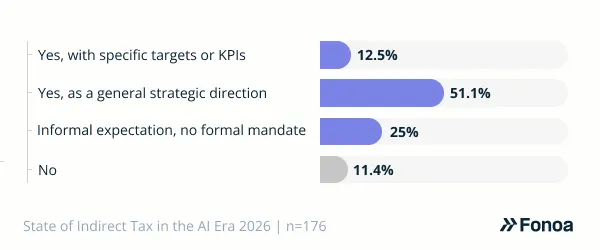
Only 12.5% have specific targets or KPIs to work toward. The rest are pushing forward without a shared definition of success, which is how a mandate turns into activity that no one can measure. As Kamal Kataria, Partner in Indirect Tax at BDO, put it:
"There's pressure to use AI, but no one really knows in what capacity. At the moment, the KPI is essentially: are we using AI? Yes or no?"
Kamal Kataria, Partner, Indirect Tax at BDO
Most tax teams can't defend their AI decisions to an authority
The question every tax leader eventually faces isn't whether AI is in the workflow. It's whether the output holds up under challenge.
Survey question: If challenged by a tax authority, how confident are you that your AI-assisted decisions would hold up?
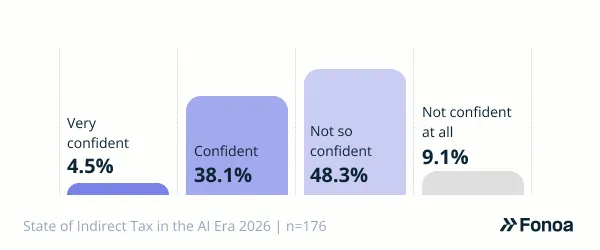
57.4% wouldn't be confident defending AI-assisted decisions to a tax authority today. Kataria reframes what that defense actually involves, and why it's a process problem more than a technology one:
"Strip away the word AI, and nothing's changed. You're not defending a technology. You're demonstrating a process."
Kamal Kataria, Partner, Indirect Tax at BDO
Why AI governance matters more than the AI model you choose
The strongest predictor of audit confidence in the entire dataset wasn't the tool a team used. It was whether a defined process sat behind the output.
Survey question: How does your organization currently validate AI outputs before they inform tax decisions?
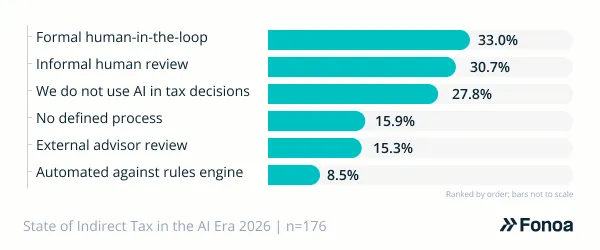
Only a third of organizations run formal human-in-the-loop review. The rest rely on informal checks, no defined process, or keep AI out of decisions entirely. Sergio Avalos, Tax Technology and Transformation Leader at KPMG, draws the line that the data confirms:
"Exploring AI with individual tools is a completely different story to building something production-ready and scaling it enterprise-wide."
Sergio Avalos, Tax Technology and Transformation Leader at KPMG
What does the State of Indirect Tax in the AI Era 2026 report cover?
The full research covers three chapters and a self-assessment.
Chapter 1: Current challenges for tax teams
Growing workload, flat headcount, and an AI mandate. The data on where tax teams spend their time and what leadership is actually asking for.
Chapter 2: How tax teams use AI today
High adoption, low automation, and a long way to production. Where AI is being tried versus relied on across 10 key indirect tax workflows, what's blocking progress, and why governance confidence is so low.
Chapter 3: What successful AI adoption looks like
The formalization cycle, the KPI effect, the three unlocks. Specific, measurable evidence of what the organizations seeing results have built, and how to build it.
Diagnostic checklist
Five questions that show where your AI accountability gap is. A self-assessment for any indirect tax leader.
How to identify your AI accountability gap
Five questions every indirect tax leader should be able to answer yes to:
- Does your organization have specific AI KPIs set by leadership?
- Do you measure time saved, cost avoided, or cycle-time reduction by AI workflow?
- Can you identify which AI-assisted decisions affected filings, determinations, or authority responses in the last 12 months?
- Can you produce a documented audit trail for those decisions?
- Is your AI grounded in current rules, transaction data, and your specific business context?
Most organizations answer no to at least three. Each no points to a specific accountability gap, and a specific action to close it. The report walks through every one.
About the research: 176 indirect tax leaders surveyed
We fielded this survey to test what we kept hearing in the field: tax functions are being asked to absorb digital-era complexity with flat or declining headcount, and the expectation is that AI fills the gap. The 176 responses confirmed it. They also showed something more useful. A small cohort has moved past experimentation into something that works, and what separates them is the accountability structure they built around their AI investment. In the words of Rob van der Woude, Chief Tax Officer at Fonoa, who introduces the report:
"The pages that follow show what the messy middle looks like, and what's waiting beyond it."
Rob van der Woude, Chief Tax Officer at Fonoa
How Fonoa Intelligence helps close the AI accountability gap
The report shows what closing the gap takes. Fonoa is how you build it. Learn more about our Intelligence layer:
Fonoa Knowledge: Personalized regulatory intelligence, cited to primary legislation and contextualized to your business. Know what changed, whether it matters to you, and what to do about it.
Fonoa Audit: Every determination, override, and approval trail assembled on demand. Audit ready in minutes, not weeks.
Download the State of Indirect Tax in the AI Era 2026 report
Get the full research from 176 indirect tax leaders, the three-chapter analysis, and the diagnostic checklist.


.jpg)