.webp)

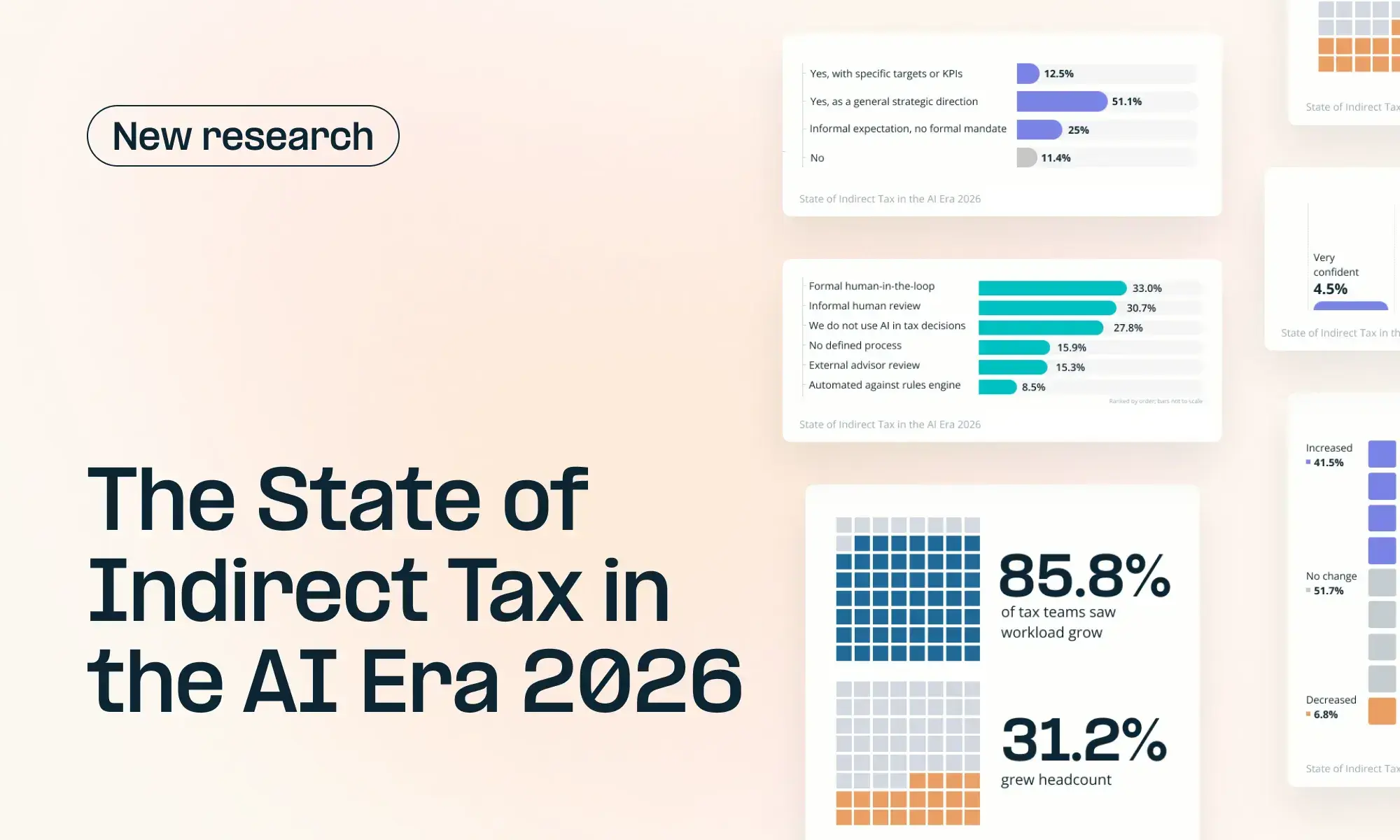
Almost all organizations are using AI in some form, but only a fraction measure what it returns with defined metrics and formal controls. We surveyed 176 tax and finance leaders for the State of Indirect Tax in the AI Era report to find out what tax teams are tracking when it comes to AI ROI, and whether those metrics are pointing in the right direction.
This is a deep dive into the KPIs that survey respondents are using to track the impact of their AI usage.
Most tax functions aren't measuring AI ROI
75% of organizations have no meaningful AI ROI measurement in place. Without something defined to measure against, it’s impossible to know whether AI is delivering.
Without an objective basis to point to, there’s no way to build a business case, justify further investment, or know whether AI is moving the function forward.
This is likely why more than a third of respondents said it was too early to tell whether AI has improved performance over the last 12 months. Without defined metrics, that answer can’t change over time.
Top KPIs teams are tracking
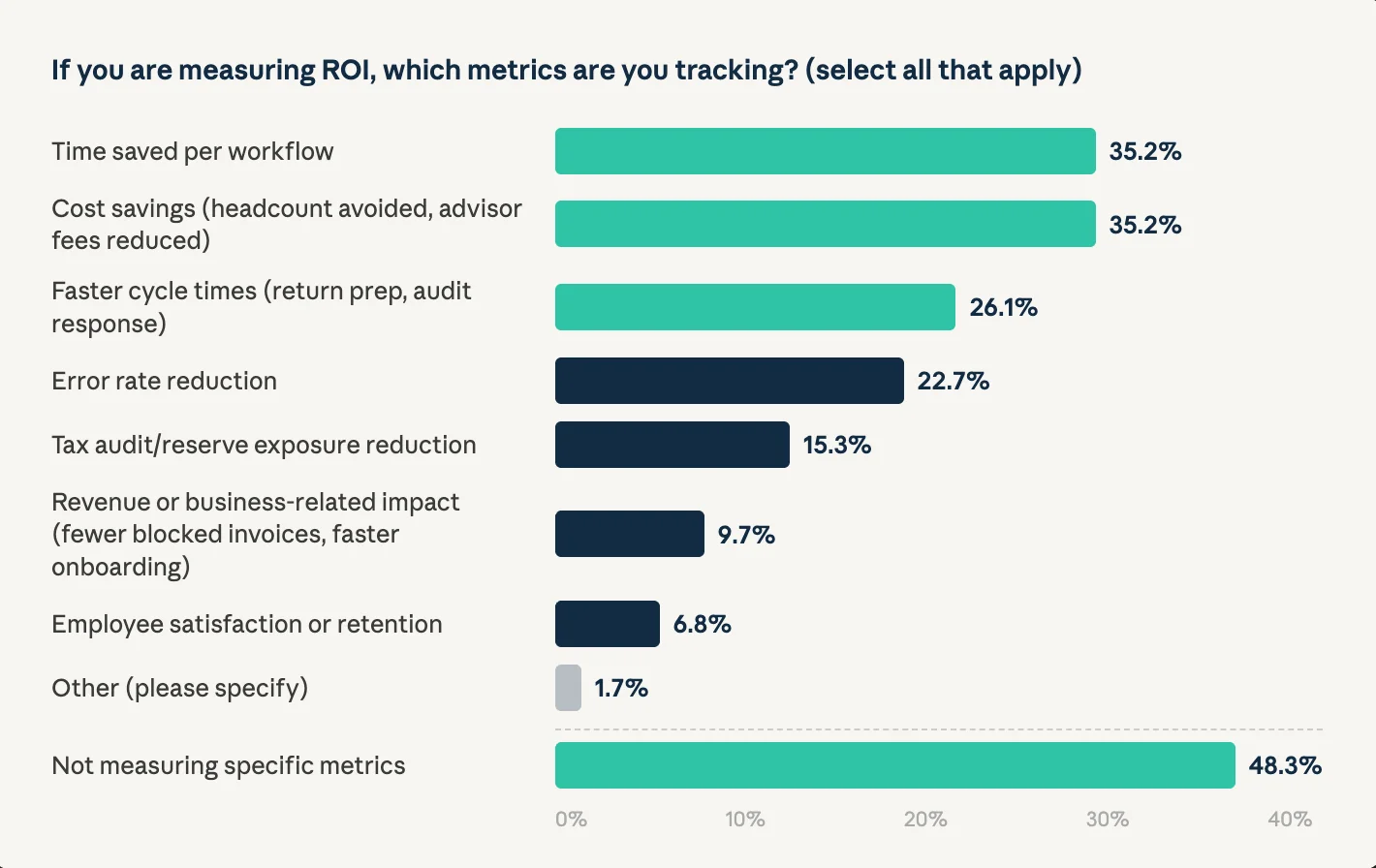
For the teams that are tracking KPIs, time saved per workflow and cost savings lead at 35.2% each, followed by faster cycle times at 26.1% and error rate reduction at 22.7%. These are knowledge work metrics: observable, easy to report, and achievable without deep system integration.
Time saved and cost savings are the most tracked KPIs. Both reflect where AI is currently deployed, not necessarily where it matters most.
Are these the right things to be tracking?
These KPIs reflect where tax AI use is concentrated today: research drafting, query responses, advisory work. A reasonable starting point, but when we asked where pressure is most unsustainable, data quality and reconciliation came out top, followed by real-time reporting and e-invoicing compliance. The workflows generating the most operational pressure are not the ones being measured.
The least tracked KPIs include tax audit exposure reduction and revenue or business-related impact. These connect AI directly to compliance defensibility and commercial outcomes, yet they sit at the bottom of the list.
Measuring these KPIs requires AI to be running inside operational workflows like determination, compliance, and return preparation, where only 3–8% of teams are in full production. The measurement follows the deployment, but the deployment isn’t there yet.
The least tracked KPIs are the ones tied to commercial and compliance outcomes. Getting AI into those workflows requires investment, and investment needs a business case.
This makes sense given where most organizations are in their AI journey, but reveals the next challenge. By starting tracking now, even in early-stage workflows, teams can build the evidence needed to take AI further.
The case for starting now
Organizations with formal AI measurement see compliance workload decrease at 8x the rate of those without.
Organizations that track AI KPIs can more quickly see what's working, where effort is being wasted, and where to invest next.
Only 2.8% of respondents are there today, but the gap between their results and everyone else’s is already widening.
Among teams with specific leadership KPIs, tracking rates for operational metrics are nearly double those operating under a more generic strategic direction [report p.17].
The current KPI distribution reflects where AI has been tried first, but not where it’s worked best. What turns that starting point into something that compounds is by tracking it. The data is already there, but now it needs to be captured in a way that can inform what comes next.
The full report covers how AI is being used across indirect tax workflows, what's blocking the move to production, and what organizations seeing results are doing differently.