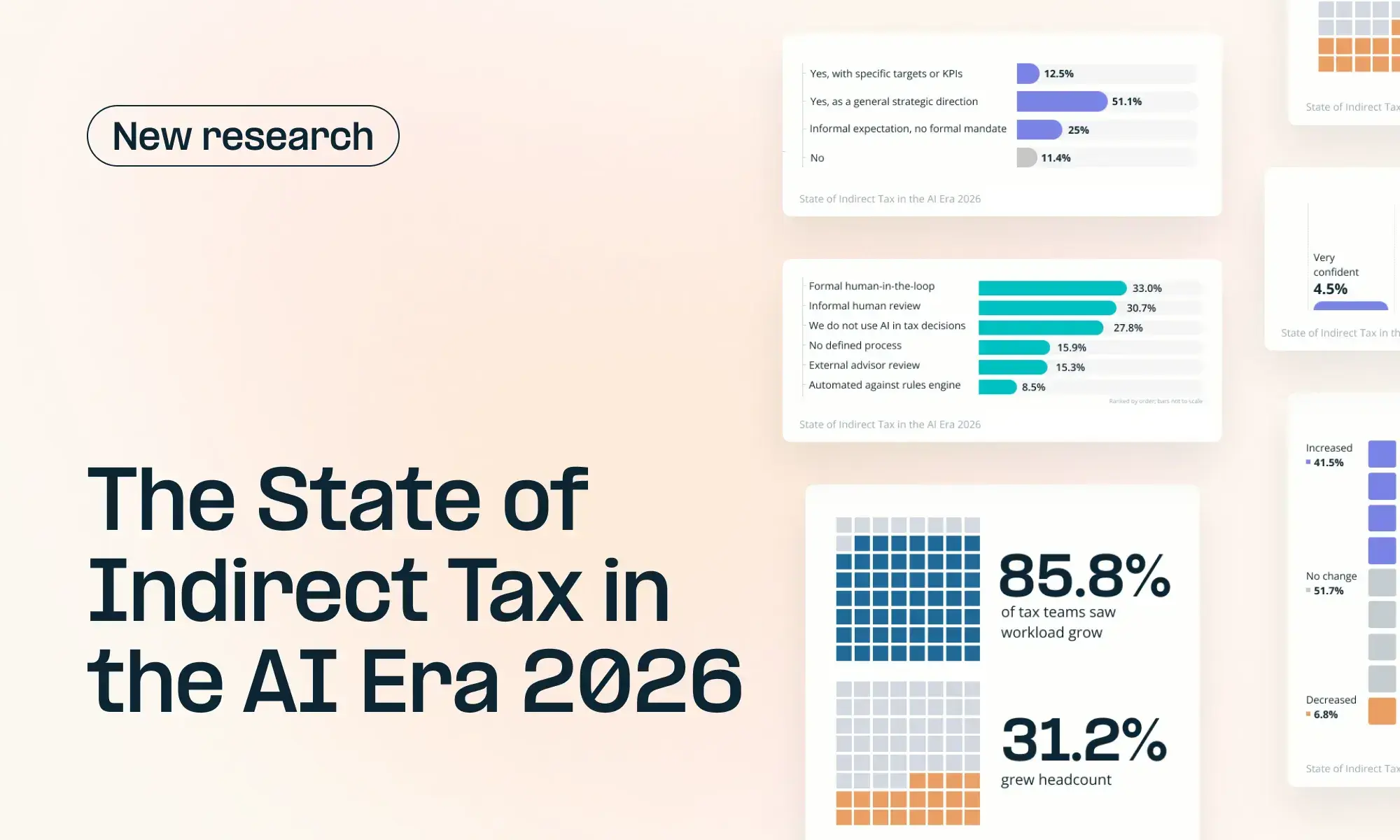

New research reveals the AI accountability gap in indirect tax
Almost every indirect tax team is now using AI. Far fewer can tell you what it returned, who governs it, or whether they could defend a single AI-assisted decision to a tax authority. That gap, between using AI and being able to account for it, is the most important finding in our new research.
We surveyed 176 tax and finance leaders for the State of Indirect Tax in the AI Era 2026. The headline number looks like progress: 92% of organizations are using AI in some form. But the moment you ask what that use produces, the picture thins out. Most teams can't measure the return, can't point to a governance process, and wouldn't be confident standing behind the output if challenged.
This post is the overview. Over the rest of the series we'll publish raw cuts of the data that didn't make the report, but the place to start is the central divide the research uncovered: the difference between the teams that built accountability around their AI and the teams that didn't.
AI adoption pressure is near universal, clear targets are not
The pressure to adopt AI is close to universal. 88.6% of tax functions are under active leadership pressure to use it. The problem isn't appetite. It's that the appetite arrived without a definition of success.
Has your organization's leadership given the tax function a mandate to adopt AI?
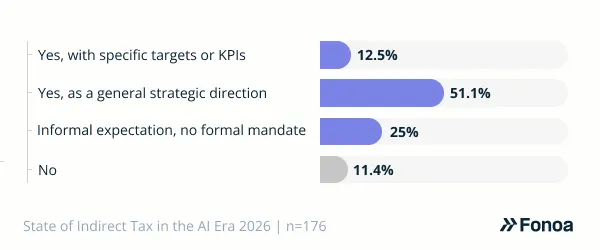
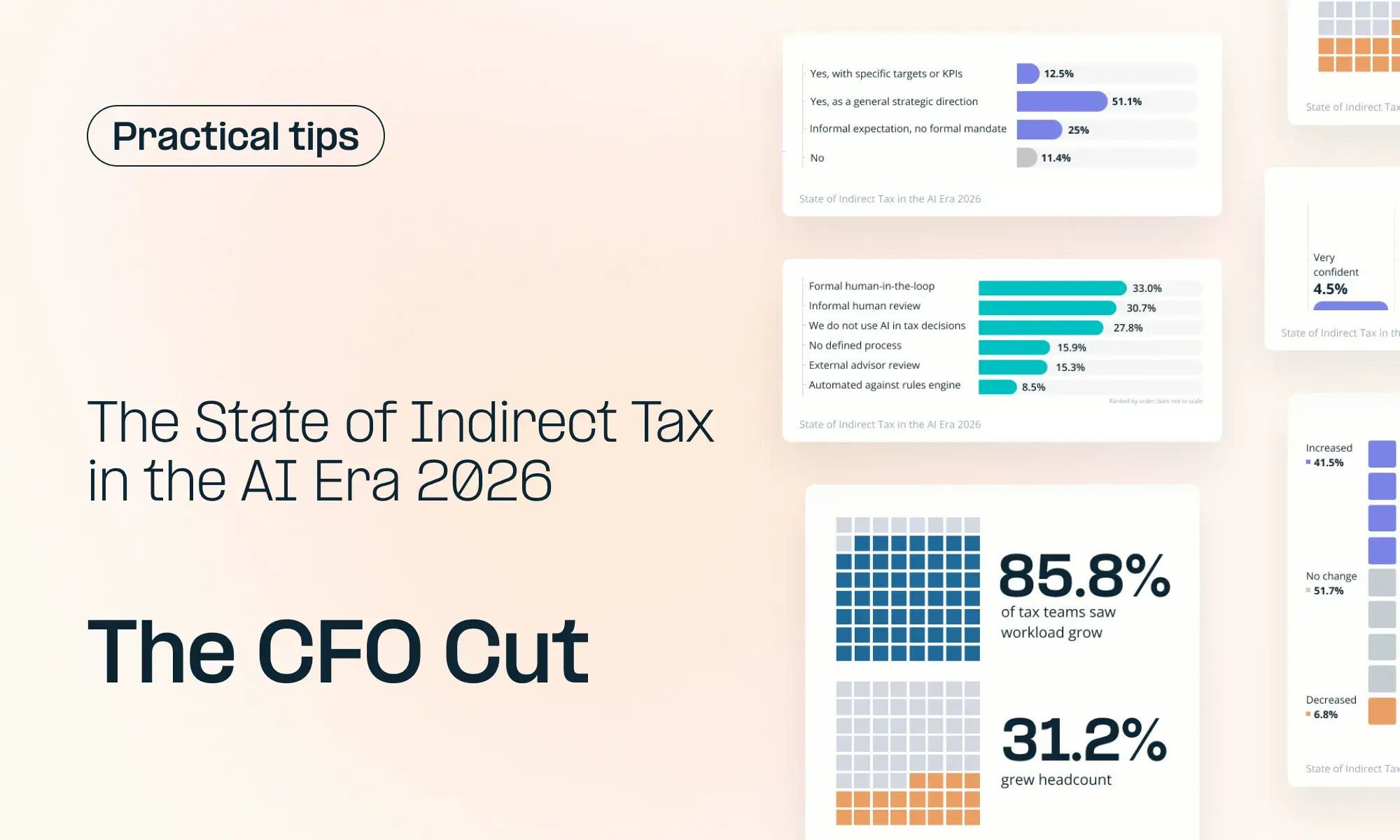
Only 12.5% of teams have been handed specific targets or KPIs. The other 76.1% are working toward a mandate that amounts to "do AI," with no shared sense of what a good outcome looks like. When leadership doesn't specify the target, the function can't build the infrastructure to hit it. As Kamal Kataria at BDO put it to us, the operating KPI for most teams is essentially: are we using AI, yes or no?
That vagueness has a predictable effect. Pressure with no direction and, for 54.5% of teams, no extra budget pushes adoption toward the cheapest available option. 60.8% of organizations rely primarily on individuals using public AI tools without governance, oversight, or an audit trail. Shadow adoption isn't the exception in indirect tax. It's the default operating mode.
AI adoption hasn't reduced indirect tax workload
If AI were closing the capacity gap, you'd expect the workload to ease. It hasn't.
Over the past 24 months:
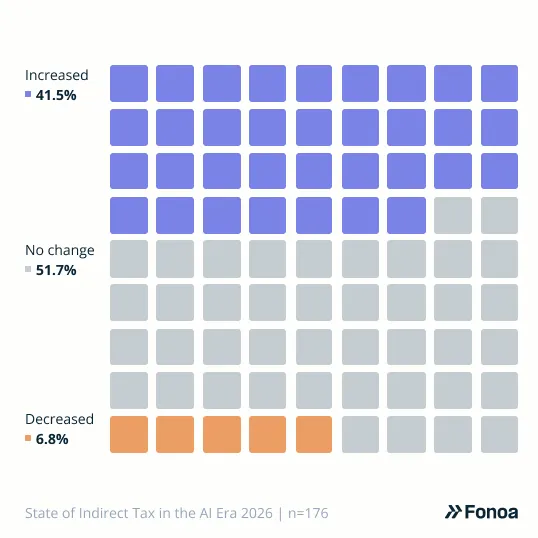
Only 6.8% of teams saw compliance workload fall over the past year. For everyone else it held flat or grew, despite more AI in the mix. The reason is structural. AI activity has concentrated in knowledge work like research and drafting, which isn't where the operational volume actually lives. The high-volume work, data reconciliation and return preparation, depends on clean data and system integration most organizations haven't built yet.
So AI lands on the tasks that were never the bottleneck, while the tasks that generate the volume stay manual. In the early stages it often adds a review step before it removes a manual one. 71% of teams have not fully automated a single indirect tax workflow end to end.
Most tax teams can't govern their AI outputs
Here's where the gap gets expensive. AI is producing outputs that feed real tax decisions, but most teams can't reconstruct how those outputs were reviewed.
Has AI use changed your team's compliance workload over the past 12 months?
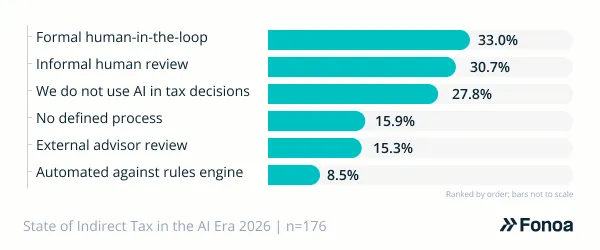
Only a third of organizations have a formal, documented sign-off process. Another 46.6% are applying AI to tax decisions through processes that wouldn't survive outside scrutiny. This matters because validation is the single largest structural differentiator in the dataset: organizations with formal human-in-the-loop governance are more than twice as likely to be confident defending their AI decisions as those with no defined process. Governance is a condition for production AI, not something you bolt on afterward.
AI tax decisions face an audit defensibility gap
The defensibility problem follows directly from the lack of process.
If challenged by a tax authority, how confident are you that your AI-assisted decisions would hold up?
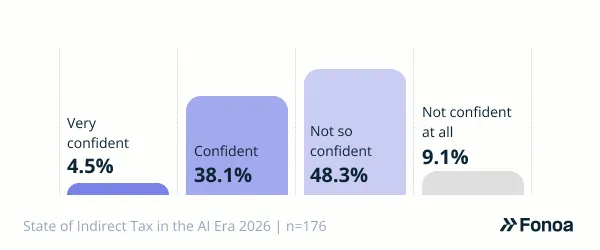
57.4% of respondents would not be confident defending an AI-assisted decision to a tax authority today. In a climate of more active tax administrations, that's real exposure. And the reason isn't model accuracy. A tax authority challenging a determination doesn't ask for a benchmark score. It asks which rule was active, who reviewed the output, and what the approval process was. Those are records, not capabilities, and most teams don't have them.
Tax workload outgrew headcount long before AI
Step back to where this began. The workload was already outrunning capacity before AI entered the picture, which is part of why leadership reached for it.
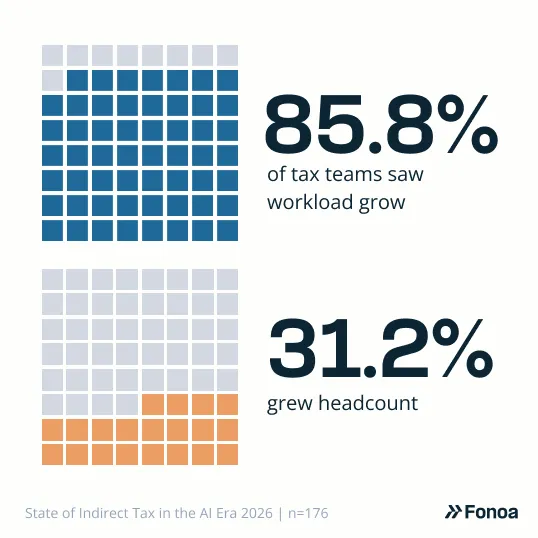
How does your organization currently validate AI outputs before they inform tax decisions?
85.8% of teams saw workload grow over the past two years. Only 31.2% grew headcount. AI was supposed to absorb that gap. So far, for most teams, it hasn't, because adoption without accountability produces activity rather than results.
AI accountability separates the leaders from everyone else
Put the findings together and a clear line emerges. The interesting split in the data isn't between organizations that use AI and organizations that don't. Nearly everyone uses it. The split is between the small cohort that built accountability structure around their AI, specific mandates, formal governance, and measurement, and the majority that didn't.
That cohort is small. Only 2.8% of organizations have reached full formalization. But the ones who push through to it see compliance workload decrease at eight times the rate of those who don't. The advantage is real, and because it compounds, the distance between those teams and everyone else is already widening.
The full report breaks down what that structure looks like, stage by stage, with a diagnostic checklist you can run against your own function. It's worth reading if AI feels like it's adding stress rather than removing it, because the data says you're not alone, and it shows what changes that.
.webp)