
What is the UAE's e-invoicing mandate?
The United Arab Emirates is introducing a nationwide Electronic Invoicing System (EIS), led jointly by the Ministry of Finance (MoF) and the Federal Tax Authority (FTA). It forms part of the UAE's wider digital-tax and data-modernisation agenda, moving VAT invoicing away from traditional document exchange toward structured digital invoicing and near-real-time tax reporting.
For businesses, this is a substantial shift. Invoicing becomes directly connected to tax-authority reporting, with Peppol-based document exchange, mandatory service-provider onboarding, and new layers of validation. As we’ve seen in other e-invoicing transformations, a PDF will no longer be a valid tax invoice for in-scope transactions.
Unlike a clearance regime, the UAE has opted for a Decentralized Continuous Transaction Control and Exchange (DCTCE) architecture (commonly described as a five-corner model) built on the Peppol network and a UAE-specific data standard called PINT-AE. Invoices are issued by suppliers, exchanged through accredited service providers, and the underlying tax data is reported to the FTA through a structured Tax Data Document (TDD).
When does UAE e-invoicing become mandatory?
The UAE is rolling out the mandate in phases, beginning with a pilot before scaling to large taxpayers, then SMEs, then government entities.
UAE e-invoicing implementation timeline
A notable transitional relief has been granted to members of the same UAE VAT group: transactions between members of the same UAE VAT group benefit from a 24-month grace period starting 1 January 2027.
Overall, this "large taxpayers first" sequencing mirrors what we are seeing across the Gulf, including Oman's Fawtara programme, but the UAE's specific deadlines and the five-corner reporting design are its own.
Who must comply with UAE e-invoicing?
The mandate applies to any person conducting business in the UAE, for every business transaction, regardless of VAT-registration status, unless specifically excluded. The main carve-outs are certain sovereign government activities, certain international airline transport (passenger permanently; air freight for a transitional 24 months), and VAT-exempt or zero-rated financial services. Because scope doesn't hinge on VAT registration, participation is anchored to a Tax Identification Number (TIN) rather than a VAT number. This TIN is the first 10 digits of a business's TRN, or a newly issued TIN for organizations not yet registered for tax.
Non-residents are in scope only where they are required under UAE VAT rules to issue UAE tax invoices. Ordinary imports of goods or services accounted for by the UAE customer under import VAT or reverse charge are not, by themselves, supplier-side UAE e-invoicing transactions.
Which transactions are in scope?
B2B and B2G transactions are in scope. On cross-border flows, exports must be reported through the network, while imports fall outside the reporting obligation.
B2C is currently excluded, and this treatment is set to be clarified in future legislation.
Document types included: Tax invoices, tax credit notes, and self-billed invoices are the core in-scope documents.
How the UAE's five-corner model works
The UAE architecture extends the familiar Peppol four-corner exchange with a fifth corner for the tax authority.
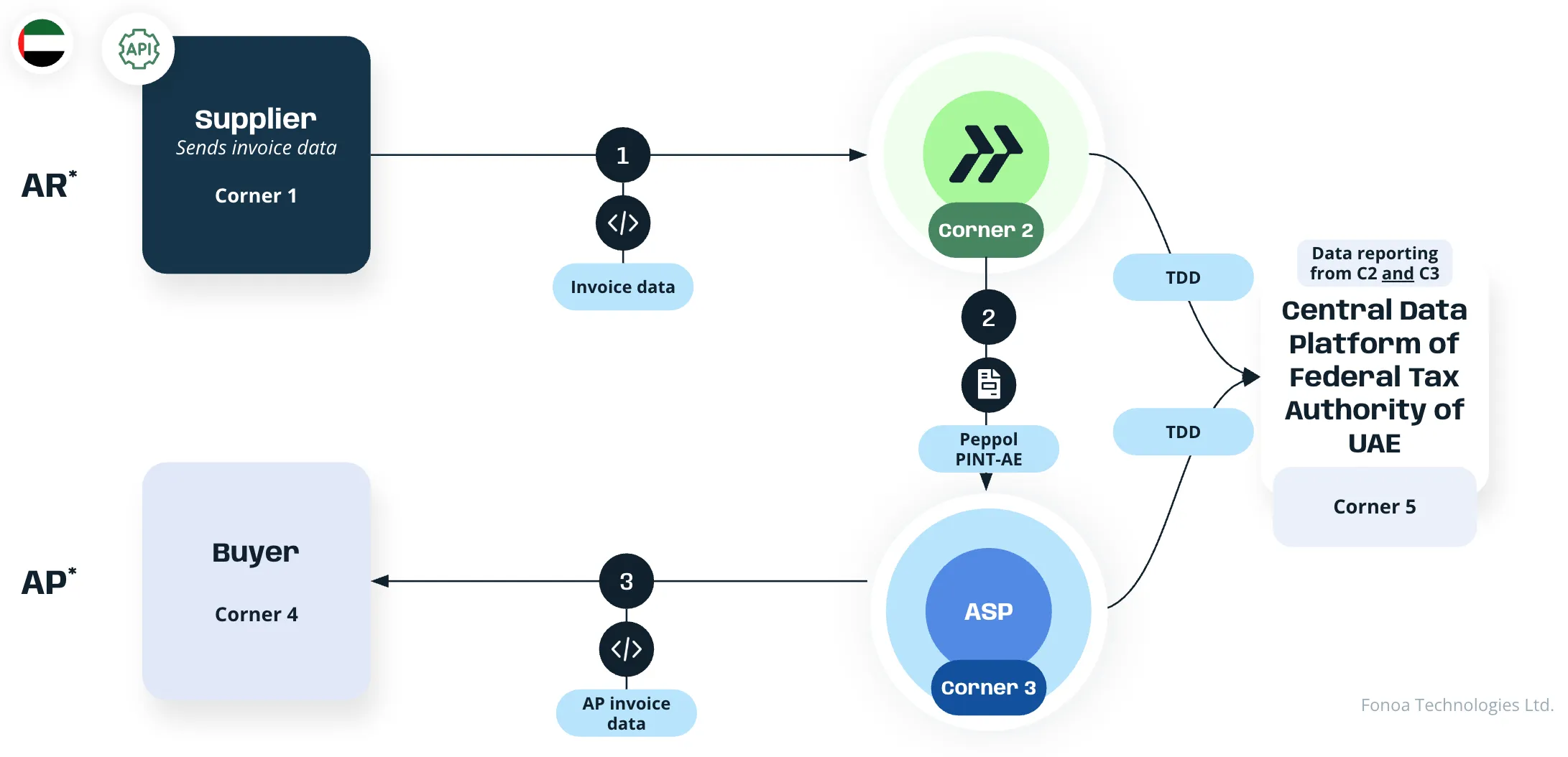
- Corner 1: Supplier. Generates invoice data in its ERP or billing system.
- Corner 2: Supplier's ASP. Validates the data, converts it to the UAE standard XML (PINT-AE), transmits it onward, and in parallel reports the Tax Data Document to the FTA.
- Corner 3: Buyer's ASP. Receives and validates the invoice, delivers it to the buyer, and reports its own TDD to the FTA.
- Corner 4: Buyer. Receives the structured invoice through its ASP.
- Corner 5: FTA. Receives and validates the structured tax data, and returns a message-level status (MLS) confirming whether the invoice and tax data were successfully exchanged and reported.
For exports, where the overseas buyer has no Peppol ID, the invoice is shared with the customer outside the network (e.g. by email) while the supplier's ASP still reports the data to Corner 5, using a predefined endpoint identifier.
Why do businesses need an Accredited Service Provider (ASP)?
Businesses cannot connect to the network directly. Every taxpayer must contract with a UAE-Accredited Service Provider (ASP), which acts as its Peppol Access Point, handles exchange with counterparty ASPs, and reports tax data to the FTA.
A few practical features of the framework:
- Onboarding is taxpayer-initiated. The taxpayer selects an ASP from the MoF's published list and initiates onboarding through the FTA's EmaraTax portal, the ASP does not start the process. Each business appoints a single ASP for all their e-invoicing needs, i.e. for both receipt and issuance of e-invoices.
- Appointing an ASP doesn't transfer liability. The ASP handles conversion, transmission, Corner-5 reporting and (contractually) storage, but the taxpayer stays accountable for the accuracy, completeness and timeliness of what reaches the FTA, and for retention. The provider does the work; the exposure sits with the business.
- Archiving stays the taxpayer's responsibility. There is no central e-archive. Records must be retained for the periods set out in the Tax Procedures Law (generally five years, extended in specific cases). An ASP may store records contractually, but the legal retention obligation never leaves the taxpayer.
What are the 6 biggest UAE e-invoicing implementation challenges?
- Know your own and your counterparties' phases. A large taxpayer live from 1 January 2027 may still transact with SME buyers who are not yet onboarded until July 2027. Transitional rules require a supplier to include a predefined endpoint identifier for buyers who don't yet have a participant ID, and to continue providing a regular (e.g. PDF) invoice alongside the electronic one until the buyer is on the system.
- Accounts payable are affected too. The obligation runs both ways. Buyers must be able to receive PINT-AE XML from every supplier and report purchase-side tax data through their ASP (Corner 3).
- Scenario coverage is broad. The Data Dictionary defines specific handling for multiple transactional scenarios, several of which carry extra fields or special endpoint identifiers. Modelling these correctly in the ERP is where most implementation effort lands.
- There is no cancellation button. Once an invoice has been reported it can't be edited or voided; corrections run through a tax credit note. And because the Peppol framework has no standalone debit note, an upward adjustment is issued as an invoice carrying a debit-note type code (383) rather than a separate document.
- Penalties are now defined. The catalogue includes a monthly charge for failing to implement the EIS or appoint an ASP, a per-document charge for invoices or credit notes not transmitted as required (subject to a monthly cap), and a daily charge for certain notification failures.
How Fonoa helps businesses comply with UAE e-invoicing
Fonoa helps businesses prepare for and comply with complex e-invoicing and digital-reporting mandates, including Peppol-based five-corner models like the UAE's.
With Fonoa, businesses can manage structured invoice generation, tax-data validation, TDD reporting, and service-provider connectivity through a single, scalable platform, rather than rebuilding invoicing infrastructure for every new jurisdiction. For the UAE specifically, that means handling PINT-AE mapping and validation, the UAE extension fields and endpoint logic, Corner-5 reporting, and the evolving technical specifications, while managing the transitional edge cases (non-onboarded buyers, exports, self-billing) correctly from day one.
For multinationals, that same integration extends across markets (the UAE, Oman's Fawtara, Saudi Arabia's ZATCA and beyond) with each country's deltas handled underneath rather than re-engineered each time.
Preparing for UAE's e-invoicing
The UAE mandate reflects the broader Gulf and global shift from post-audit models toward continuous, decentralised, interoperable tax controls. The five-corner design signals a clear preference for Peppol-based interoperability across the Middle East and Africa.
For businesses operating in the UAE, the message from the latest MoF publications is that the programme has moved from policy to execution. The practical checklist is straightforward: confirm which phase applies, assess ERP and master-data readiness, map data to the PINT-AE Data Dictionary (including the UAE deltas), shortlist and appoint an accredited ASP, and prepare both AR and AP flows for structured exchange and reporting. For large taxpayers, with an ASP deadline of 30 October 2026 and go-live on 1 January 2027, that work is a top 2026 priority.
Frequently asked questions about UAE e-invoicing
"We already support Peppol, are we compliant?"
Not necessarily. PINT-AE adds UAE-specific identifiers, extension fields, subdivision and currency rules on top of base Peppol BIS. A valid generic Peppol invoice can still be rejected by the UAE network.
Is the UAE following Saudi Arabia's model?
No. Saudi Arabia's ZATCA uses a clearance model; the UAE uses a decentralised Peppol five-corner exchange-and-reporting model, closer in principle to Oman's Fawtara programme.
How does the UAE's five-corner model differ from a clearance model?
In a clearance model the tax authority sits in the middle and must approve each invoice before it can be exchanged, whereas the UAE's five-corner model lets accredited providers exchange invoices directly and report the tax data to the FTA in parallel.
Is a PDF invoice still valid under the new regime?
No. For in-scope B2B and B2G transactions, only structured PINT-AE XML exchanged through an accredited ASP counts as a valid e-invoice; PDFs, Word files, scanned copies and emailed invoices do not.
What's actually out of scope?
The main carve-outs are certain sovereign government activities, certain international airline transport, and VAT-exempt or zero-rated financial services, plus B2C, which sits outside the mandate until future legislation addresses it.
Can businesses use more than one Accredited Service Provider (ASP)?
No. Each taxpayer onboards with a single ASP for both issuance and receipt of e-invoices, so one provider carries the full AR and AP flow.
Will UAE e-invoicing support international invoice exchange?
The UAE mandate itself is domestic (exports are in scope, reported to the FTA through the network), but because it sits on the Peppol network, used across 40+ countries, the underlying infrastructure supports cross-border exchange with other Peppol-enabled jurisdictions as regional frameworks mature, though each country's local schema (PINT-AE in the UAE, PINT-MY in Malaysia, and so on) still governs what's valid at home.
Will the UAE e-invoicing requirements continue to evolve?
Yes. The framework has already been amended once (the May 2026 update to deadlines and the ASP accreditation rules), B2C treatment is expected to be addressed in future legislation, and the FTA has signalled that exclusions and technical specifications will be reviewed as the system matures.