
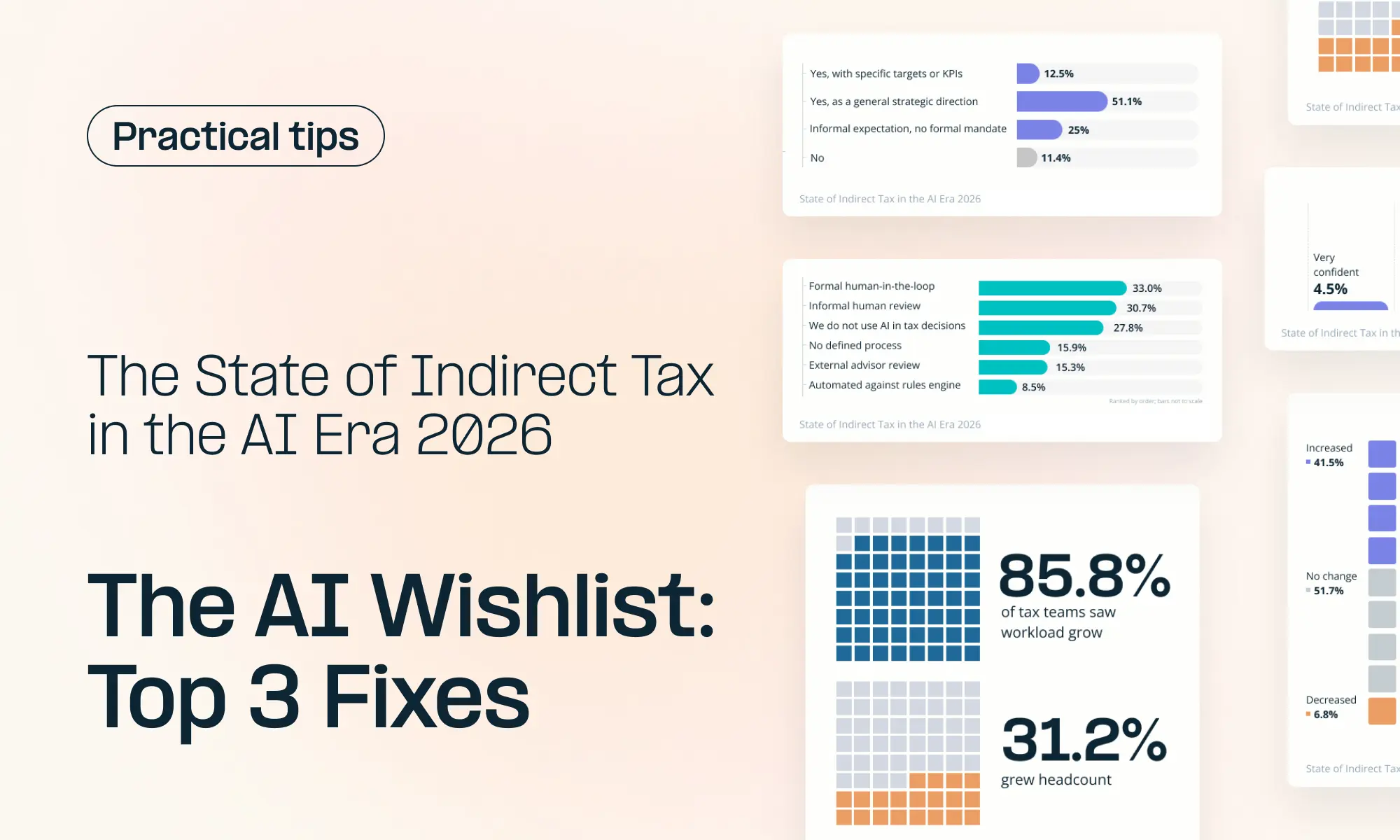

We asked 176 indirect tax professionals an open question: if you could solve one thing about indirect tax with AI in the next 12 months, what would it be?
The answers clustered around operational efficiency. What tax leaders want is straightforward: relief from the work that never stops.
What do tax leaders want AI to solve first?
The responses fell into three broad areas:
- Operational workload: return preparation and data reconciliation, accounting for over half of all responses.
- Trust and reliability: whether AI outputs can actually be relied on
- Compliance confidence: audit trails, regulatory tracking, e-invoicing, and cross-border complexity
1. Tax leaders want AI to automate return preparation and reconciliation
Return preparation and data reconciliation account for more than half of responses. These are the recurring workflows that involve the most manual steps and generate the most room for error.
“The biggest pain is not tax calculation itself. It is the messy operational layer around it [...]. The outcome I'd want: fewer filing surprises, cleaner audits, faster close, and less manual review by Finance/Ops.” VP of Finance at Enterprise Software Company
The ask isn't for AI to replace tax judgement. It's for AI to manage the operational complexity surrounding it. The value isn't just time saved, but a function that runs cleaner and carries less risk into every filing.
Many respondents reported the same fragmentation issue. Indirect tax compliance is rarely boxed into one process. It's distributed across ERPs, billing platforms, external advisors, regional entities, and all this reconciliation work becomes a burden because those pieces don't naturally connect.
"The VAT return process today is so fragmented and spread across teams. This would be a gamechanger - one hub, a small team, able to submit and manage all VAT compliance for all entities." VAT Manager at Global Consumer Packaging Company
A unified operational layer reconciles the constant stream of exceptions and mismatches that pull tax teams back into the weeds every month.
2. Tax teams need AI outputs they can trust
Roughly one in six responses raised another concern: will the output be reliably accurate?
"Stopping hallucinations is step 1. Tax has zero tolerance for hallucinations which makes AI challenging to implement." COO at Global Technology Company
When a tool produces confident-sounding output that turns out to be wrong, it both causes a filing problem and erodes the trust that makes adoption possible at all. The standard needed for enterprise tax is AI that’s grounded in current rules and transparent about its reasoning.
3. AI-assisted tax decisions must be audit-defensible
The remaining responses touched on audit-defensibility, regulatory change monitoring, e-invoicing mandates, and cross-border complexity, connected by a need for AI that produces outputs you can stand behind.
"AI can generate outputs quickly, but tax teams still need confidence that filings are traceable, explainable, and supported by evidence that would withstand scrutiny from tax authorities." Indirect Tax Manager at Global Technology Company
Without traceability, faster filing just means faster exposure and errors you can’t explain.
Why data quality is essential for AI in indirect tax
Though the aspirations for AI use are there, several responses flagged an important practical reality: AI works with the data you give it. If invoices are mismatched, systems aren't connected, or transaction records are incomplete, automating those processes doesn't fix the problem. It brings it on faster.
A few respondents named this directly, asking not just for AI but for help cleaning and standardizing data as part of the same effort, for example: “use AI to reconcile balance sheet and VAT ledgers, assist with data clean up.” Progress comes from treating data quality as part of the AI rollout because the two are inseparable in practice.
What tax leaders’ AI priorities tell us
Tax leaders know exactly where AI has the highest potential to create value for their function. They're asking for tools that reduce the operational weight of compliance, that they can trust, and that they can defend.
That's a specific, achievable brief, which is why we built our two AI tools, Knowledge and Audit, around it. Knowledge tackles the regulatory monitoring problem directly by tracking rule changes across jurisdictions and surfacing only what affects you. Audit addresses the defensibility gap, giving every tax determination a traceable, explainable record that holds up to scrutiny.
Standardizing tax automation is what’s going to evolve businesses from experimentation to something repeatable, and more importantly, reliable.
.webp)







.jpg)