
Why detecting regulatory change isn't enough
Say you catch a change in time. A country updates a VAT rate, effective next month. Good. You knew early, you have the source, you are ahead of it.
Now what? Someone has to work out whether it affects you, and by how much, and then someone has to change the setting in the system that applies the rate. The alert did not do that. It handed you a task.
Why regulatory changes fail to become tax system updates
In most setups, detection and action are disconnected. The intelligence lives in one place, usually an inbox or a research tool, and the systems that actually determine tax and generate invoices live somewhere else. A human carries the change across the gap, interprets it, and updates a configuration by hand.
That gap is where changes get dropped, misjudged, or applied late. Knowing a rule changed does not help if your tax engine still has the old rate on the day the new one takes effect.
How to connect regulatory change to tax system updates
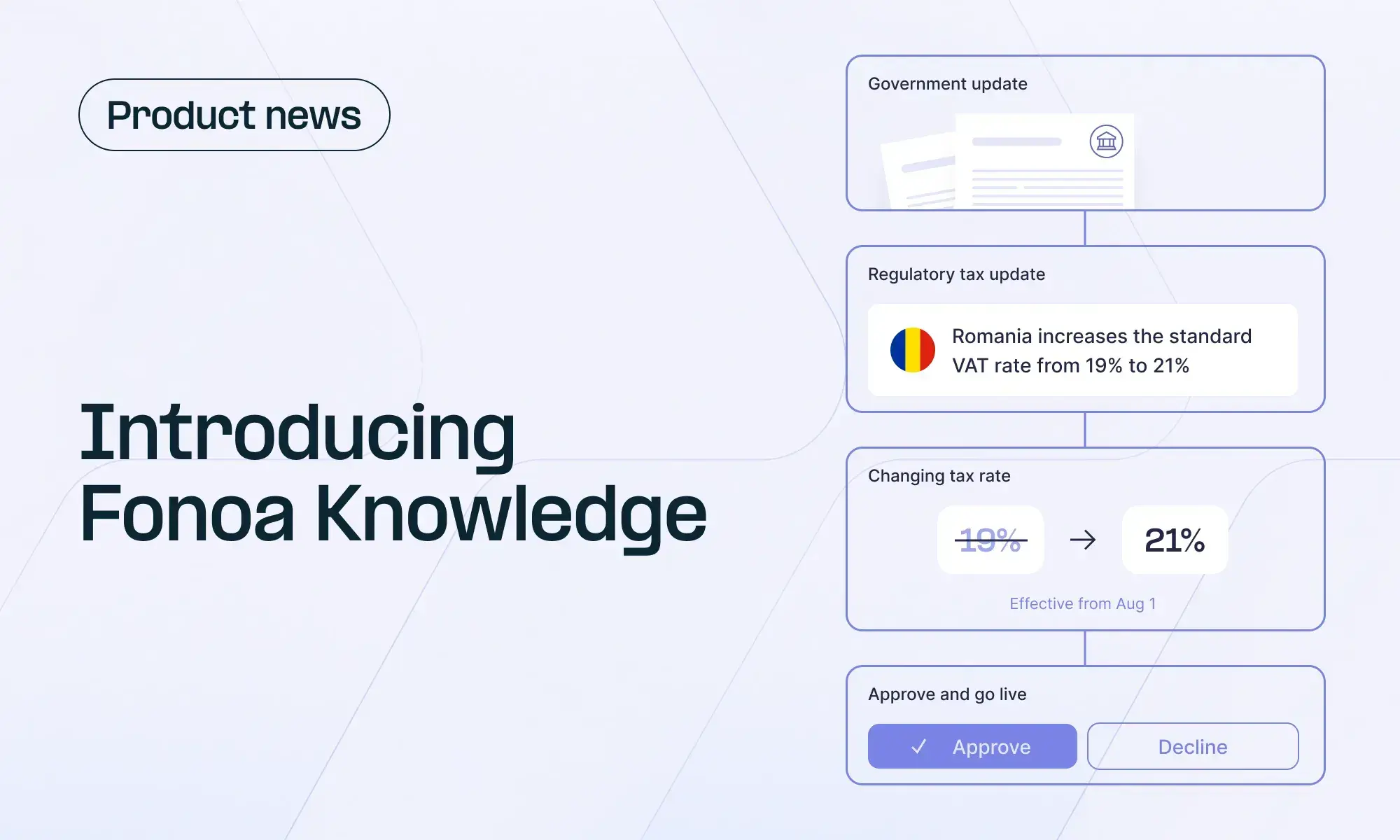
The destination is a system where the three steps connect:
- Detect the change.
- Assess whether it affects you, ideally against your actual transaction data rather than a generic maybe.
- Act, updating the configuration in the same platform that runs the compliance, with a human approving the change and an audit trail recording it.
This is where running your intelligence and your compliance on one platform stops being a nice-to-have. If Knowledge sees the change and your tax engine is on the same system, the path from detection to update has no handoff to drop.
What's next for Fonoa Knowledge: from detection to action
Detection is the foundation and it's live now, across 80 countries, relevant and trusted. What we're building on top of it is what turns detection into leverage.
Next: the ability to ask the legislation direct questions, and an entity-level read on whether a change actually touches your business, not a generic maybe, a specific yes or no against your own data. Beyond that: assisted execution, with a human approval gate, so the path from "this changed" to "this is handled" has no gap left in it.
We're building this in sequence on purpose. Detection has to be trustworthy before assessment matters. Assessment has to be sharp before action can be trusted to follow it. Each layer earns the next.
Stay tuned, the destination is a system where a regulatory change and a compliant system update are the same event.
If you want to see where it starts, Fonoa Knowledge is live now across 80 countries. Get a Knowledge demo.