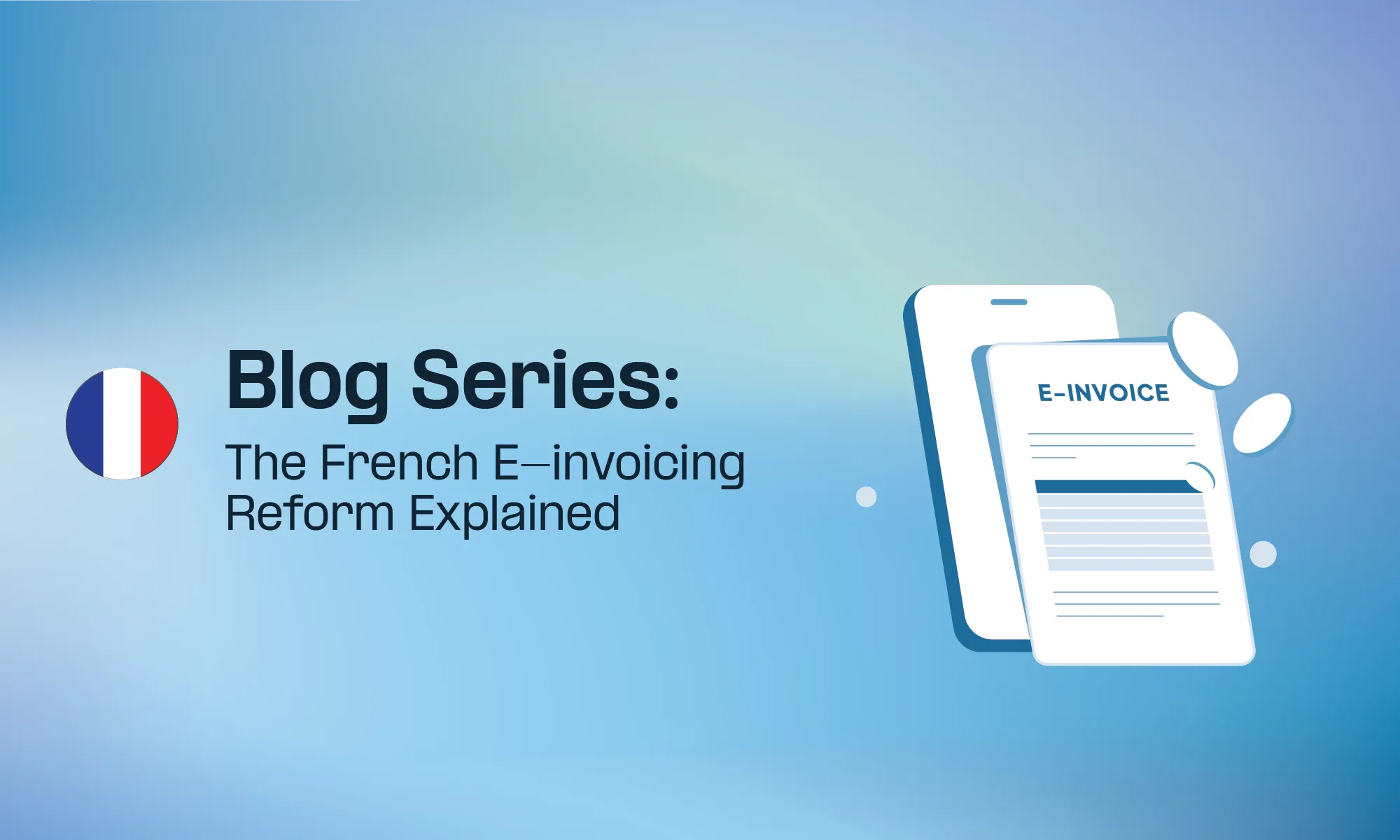

France is implementing one of the most ambitious e-invoicing reforms in Europe.
From 1 September 2026, all businesses established in France must be able to receive electronic invoices for domestic B2B transactions. At the same time, large and mid-sized enterprises will be required to issue electronic invoices and transmit transaction data to the French tax authorities.
In this introductory article, we outline the reform's primary objectives, explain the e-invoicing and e-reporting requirements, identify the phased rollout timeline, and clarify which transactions fall within scope.
In the remainder of this series, we will cover:
- The French 5-corner model and the respective roles of Accredited Platforms, the Public Invoice Portal, and the Central Directory.
- The detailed e-invoicing lifecycle, including mandatory statuses, corrections, and key edge cases.
- The e-reporting framework, including B2C, cross-border B2B and payment data reporting.
Together, these articles provide a practical guide to understanding and preparing for the French e-invoicing reform.
Objectives of the France e-invoicing reform
The reform pursues several strategic objectives: reducing the VAT gap, combating fraud, increasing transparency, and ultimately enabling pre-filled VAT returns.
In practical terms, the reform establishes a continuous, structured data flow between businesses and the tax administration.
2 core components of the French Reform: E-invoicing and e-reporting
The reform is built around two distinct but interconnected components.
E-invoicing requirements for domestic B2B transactions in France
E-invoicing applies to domestic B2B transactions between VAT-registered businesses established in France where French invoicing rules apply.
Invoices must be issued in a structured electronic format and exchanged through an Accredited Platform (Plateforme Agréée – PA). As part of this process, a defined subset of invoice data is transmitted to the tax authorities.
A paper invoice or a PDF sent by email will no longer qualify as a compliant invoice for these transactions.
E-Reporting requirements for B2C and cross-border B2B transactions
E-reporting applies to transactions that fall outside domestic B2B e-invoicing. This includes:
- B2C transactions (domestic and cross-border).
- Cross-border B2B transactions.
- Certain payment data.
For these transactions, there is no requirement to exchange a structured invoice through the platform network. Instead, businesses must transmit defined transaction data to the tax administration via their PA.
Importantly, both e-invoicing and e-reporting are carried out through PAs. Businesses do not transmit data directly to the tax administration. The role of PAs and the mechanics of the 5-corner model will be examined in the next article.
France e-invoicing implementation timeline (2026–2027)
The reform is being implemented in phases.
From September 1, 2026:
- All businesses must be able to receive electronic invoices.
- Large enterprises and mid-sized companies must begin issuing electronic invoices.
- Their corresponding e-reporting obligations also commence on that date.
From September 1, 2027:
- Small and medium-sized enterprises (SMEs) and micro-enterprises must begin issuing electronic invoices.
- Their e-reporting obligations begin at the same time.
Even businesses not required to issue invoices until 2027 must be operationally ready to receive invoices from September 2026. This distinction is critical for implementation planning.
Company size categories are generally defined as follows:
- Large enterprises: more than 5,000 employees, or turnover exceeding €1.5 billion and a balance sheet total above €2 billion.
- Mid-sized companies: between 250 and 5,000 employees, and turnover not exceeding €1.5 billion or a balance sheet total not exceeding €2 billion.
- SMEs: fewer than 250 employees and turnover not exceeding €50 million or a balance sheet total not exceeding €43 million.
- Micro-enterprises: fewer than 10 employees and turnover or balance sheet total not exceeding €2 million.
Businesses in scope of the French e-invoicing reform
The reform applies broadly to businesses established in France that are subject to VAT, regardless of size. This includes large enterprises, mid-sized companies, SMEs, micro-enterprises and businesses benefiting from the VAT franchise regime (franchise en base de TVA).
Although businesses under the VAT franchise regime do not charge VAT on their sales and cannot deduct input VAT, they remain taxable persons for VAT purposes and are therefore required to comply with the e-invoicing obligations and, where applicable, the e-reporting requirements.
Businesses that are not established in France are exempt from the domestic B2B e-invoicing mandate, as this requirement applies only when both the issuer and the recipient are established in France.
However, when non-established entities fall within the scope of the e-reporting mandate, their implementation timeline depends on two key factors: the size of the company and its role in the transaction (i.e., whether it acts as the supplier or the buyer).
The rollout is phased as follows:
- September 1, 2026: E-reporting obligations apply to large enterprises and mid-sized companies, but only for transactions where they act as the seller or service provider.
- September 1, 2027: E-reporting obligations apply to SMEs and micro-enterprises acting as sellers or service providers, as well as to all non-established entities acting as the acquirer or recipient (i.e. purchasing goods or receiving services), regardless of size.
For non-established businesses, the scope is not automatic and requires a careful analysis of transaction flows. The reporting obligation depends on several factors, including:
- Whether the transaction is deemed located in France for VAT purposes.
- Whether the business is liable for French VAT.
- The role of the business in the transaction (supplier or buyer).
Additionally, certain non-established suppliers may fall outside French e-reporting where the relevant transactions are declared through the European One-Stop Shop (OSS or IOSS). Foreign businesses must therefore assess not only where transactions are deemed located, but also how VAT is declared and under which regime.
Transactions covered by France’s e-invoicing and e-reporting rules
At a high level:
- Domestic B2B transactions between French VAT-registered businesses fall under e-invoicing.
- B2C transactions (domestic and cross-border) and cross-border B2B transactions fall under e-reporting.
- Certain reverse-charge acquisitions may also trigger reporting obligations for the French-established party.
Correct classification is essential. It is not sufficient to look at the legal form of the counterparty. VAT place-of-supply rules, establishment status, and the nature of the transaction must all be considered.
French overseas territories
France’s overseas territories require particular attention because not all are within the French VAT territory.
Guadeloupe, Martinique and La Réunion are within the French VAT scope. Therefore, domestic B2B transactions involving VAT-registered businesses established in these departments (or trading with mainland France) are subject to the mandatory e-invoicing flow.
Guyane, Mayotte, the French Overseas Collectivities (COM, such as French Polynesia and New Caledonia), and the French Southern and Antarctic Lands (TAAF) are legally outside the French VAT territory. Transactions involving these territories generally fall under e-reporting rather than e-invoicing.
Misclassifying overseas flows is a frequent compliance risk and should be carefully reviewed as part of any readiness assessment.
Frequently asked questions about the French e-invoicing reform
When does the French e-invoicing reform start?
France’s e-invoicing reform begins on September 1, 2026. From that date, all businesses established in France must be able to receive electronic invoices, while large and mid-sized enterprises must also issue electronic invoices and comply with e-reporting obligations.
Who must comply with the French e-invoicing and e-reporting mandate?
The reform applies to businesses established in France that are subject to VAT, including large enterprises, mid-sized companies, SMEs, micro-enterprises, and businesses operating under the VAT franchise regime.
Non-established businesses are not subject to the domestic B2B e-invoicing obligation. However, they may fall within the scope of e-reporting where they carry out transactions that are taxable in France.
What is the difference between e-invoicing and e-reporting in France?
E-invoicing applies to domestic B2B transactions between taxable businesses established in France.
E-reporting applies to transactions outside that scope, including B2C transactions, cross-border B2B transactions and, in certain cases, payment data.
What formats are allowed under the French e-invoicing system?
Invoices must be issued in a structured electronic format and transmitted through an Accredited Platform (Plateforme Agréée – PA). The French reform allows three formats:
- UBL (Universal Business Language)
- CII (Cross Industry Invoice / UN-CEFACT)
- Factur-X – a hybrid format combining a human-readable PDF with embedded structured XML data
Simple PDFs or paper invoices will not meet the new compliance requirements.
When must SMEs comply with French e-invoicing?
Small and medium-sized enterprises and micro-enterprises must begin issuing electronic invoices and complying with e-reporting obligations from September 1, 2027, although they must be able to receive electronic invoices from September 2026.